

Person
Ben Mathews
ORCID:
Journal article
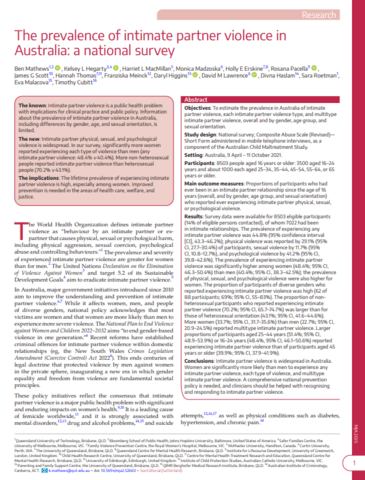
The prevalence of intimate partner violence in Australia: a national survey
This article presents the results of a survey into the prevalence in Australia of intimate partner violence (IPV), each IPV type and multitype IPV, overall and by gender, age group and sexual orientation. It finds improved prevention is needed in the areas of health care, welfare and justice and that a comprehensive national prevention policy...
Report
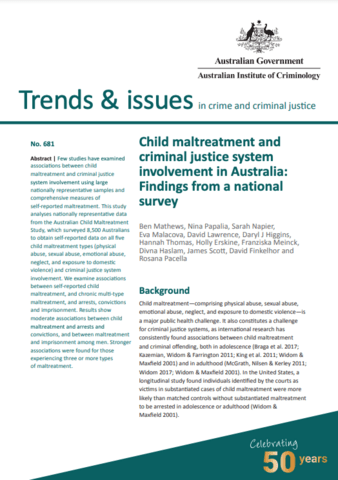
Child maltreatment and criminal justice system involvement in Australia: findings from a national survey
Few studies have examined associations between child maltreatment and criminal justice system involvement using large nationally representative samples and comprehensive measures of self‑reported maltreatment. This study analyses nationally representative data from the Australian Child Maltreatment Study.

Report
The prevalence and impact of child maltreatment in Australia: findings from the Australian Child Maltreatment Study
The Australian Child Maltreatment Study randomly surveyed 8503 randomly selected Australians (aged 16-65+). The researchers then generated the first, nationally representative rates of all five types of child maltreatment (physical abuse, sexual abuse, emotional abuse, neglect, and exposure to domestic violence) and their associated outcomes in Australia. The findings underscore the moral and economic imperative...
Journal article
The prevalence of child maltreatment in Australia: findings from a national survey
This national study estimated the prevalence in Australia of each type of child maltreatment; to identify gender- and age group-related differences in prevalence.
Journal article
The prevalence and nature of multi-type child maltreatment in Australia
The objective of this study was to determine the prevalence in Australia of multi-type child maltreatment, defined as two or more maltreatment types (physical abuse, sexual abuse, emotional abuse, neglect, or exposure to domestic violence) and to examine its nature, family risk factors, and gender and age cohort differences.