

Prison administration
Report
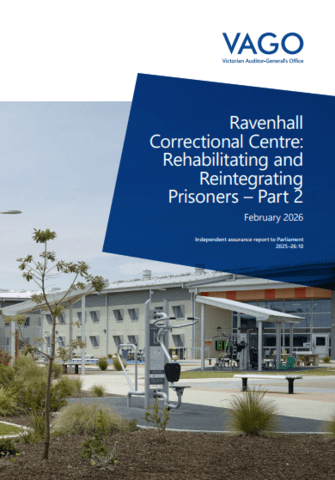
Ravenhall Correctional Centre: rehabilitating and reintegrating prisoners – Part 2
Rehabilitating and reintegrating prisoners is critical for improving community safety and reducing the high cost of running prisons. Ravenhall Correctional Centre, a private prison in Victoria, offers a unique model for reducing reoffending. This audit finds Ravenhall's overall results for reducing reoffending fall short of performance targets and is similar to other Victorian adult male...
Report
The cost of prisons in 2025
Australia’s reliance on incarceration for a wide range of offences has come at a significant financial cost to taxpayers while failing to improve community safety. This report outlines the cost of prisons, trends in incarnation, the incarceration of non-violent offenders and recommendations for reform. It finds the reliance on incarcerating non-violent offenders is straining prison...
Report
Video visitation in Australian prisons: perspectives on father–child contact
This paper presents the findings from the first multi-jurisdictional study to explore the experiences and impacts of video visits between fathers in prison and their children. Findings show that there are significant benefits to video visitation for fathers, children and children’s carers, and corrective services.

Report
Special report on corrections
IBAC performs an important role in exposing, investigating and preventing corruption across the public sector, including the corrections sector. This report focuses on four investigations – Operations Rous, Caparra, Nisidia and Molara – outlining the corruption issues involved, factors that may contribute to these issues recurring, and ways to reduce corruption risks.
Blog post
Freedom of expression and the ban on Arabic in NSW prisons – analysing Hamzy v Commissioner of Corrective Services [2020] NSWSC 414
The NSW Supreme Court’s judgment in Hamzy v Commissioner of Corrective Services, handed down in April 2020, upholds the legality of NSW’s English-only rules on communication by 'extreme high risk restricted' (EHRR) inmates. It provides a rare insight into Australian judicial thinking about freedom of expression, racial and linguistic discrimination and what it means, legally...