

Guide
 SHARE
SHARE
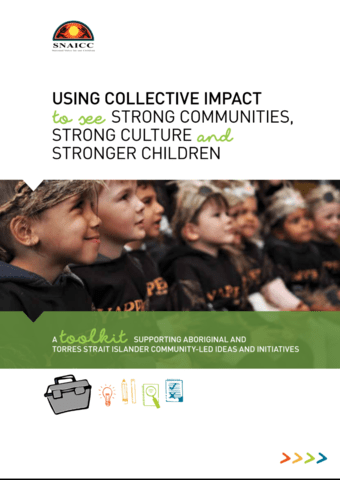
Using collective impact to see strong communities, strong culture and stronger children
A toolkit supporting Aboriginal and Torres Strait Islander community-led ideas and initiatives
Publisher
First Peoples child protection
First Nations youth
First Nations children
First Peoples families
Australia
Resources
| Attachment | Size |
|---|---|
 Using collective impact to see strong communities, strong culture and stronger children Using collective impact to see strong communities, strong culture and stronger children
|
2.05 MB |
Description
This toolkit includes a brief overview of a collaborative impact project approach, as well as activities that may be useful across the lifespan of an idea or project. The activities are standalone but also designed to complement each other.
Key Findings:
- Aboriginal leadership and engagement from the start: ensuring that Aboriginal and Torres Strait Islander people have ownership and leadership of initiatives, which will often lead to more positive and sustainable outcomes. This includes building cultural competency through Aboriginal leadership and acknowledging the power imbalances that exist between Aboriginal and Torres Strait Islander organisations and non-Indigenous organisations and groups.
- Although many ideas may be generated by your group, it is also critical to invest time in researching and assessing which ideas are most likely to support better outcomes for Aboriginal and Torres Strait Islander children and families and also identify what doesn’t work.
- As you try new ways to address issues in your community, you may find that developmental evaluation is useful. Developmental evaluation is a process that can be steered by your group and can provide you with a continuous, real-time feedback loop while your activities are underway.
As issues facing communities can be complex, this toolkit focuses on activities that are easy to adapt to dynamic environments. It reflects the research on good practice in partnerships and programs for Aboriginal and Torres Strait Islander children and families, and incorporates activities developed, used or adapted by SNAICC with partners across a number of projects and policy processes.
Publication Details
Copyright:
SNAICC 2019. Reproduced with permission
License type:
All Rights Reserved
Access Rights Type:
open
Post date:
7 Apr 2020
Collections
More like this
