

Report
 SHARE
SHARE
How police body-worn cameras can facilitate misidentification in domestic and family violence responses
Asher Flynn, Danielle Tyson
Publisher
Wearable technology
Police
Material evidence
Electronic surveillance
Family violence
Victims of family violence
Australia
Justice 2024
Resources
| Attachment | Size |
|---|---|
 How police body-worn cameras can facilitate misidentification in domestic and family violence responses How police body-worn cameras can facilitate misidentification in domestic and family violence responses
|
407.48 KB |
Description
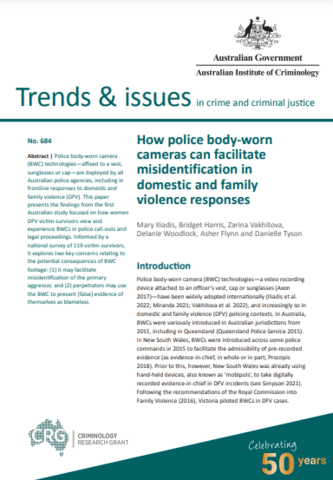
Police body-worn camera (BWC) technologies—affixed to a vest, sunglasses or cap—are deployed by all Australian police agencies, including in frontline responses to domestic and family violence (DFV). This paper presents the findings from the first Australian study focused on how women DFV victim-survivors view and experience BWC technology in police call-outs and legal proceedings.
Informed by a national survey of 119 victim-survivors, it explores two key concerns relating to the potential consequences of BWC footage:
- it may facilitate misidentification of the primary aggressor, and
- perpetrators may use the BWC to present (false) evidence of themselves as blameless.
Publication Details
DOI:
10.52922/ti77277
ISBN:
978-1-922877-27-7
Copyright:
Australian Institute of Criminology 2024
License type:
All Rights Reserved
Access Rights Type:
open
Series:
Trends and issues in crime and criminal justice, no.684
Post date:
13 Feb 2024
