

 SHARE
SHARE
Culturally and racially marginalised girls and young women in South West Sydney
| Attachment | Size |
|---|---|
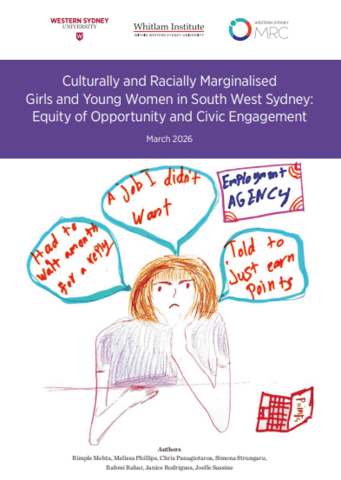
 Culturally and racially marginalised girls and young women in South West Sydney Culturally and racially marginalised girls and young women in South West Sydney
|
3.31 MB |
This report is the outcome of research conducted with culturally and racially marginalised (CARM) girls and young women from migrant and refugee backgrounds in South West Sydney in 2025. The aim of the research was to explore the barriers and enablers impacting girls and young women's civic engagement and their aspirations within Australian society – that is, their relationship to the Australian state through rights, services, obligations and formal participation; and their aspirations within Australian society through a place-based approach.
The research supports findings from existing studies that show CARM youth face overlapping structural barriers spanning employment, education, finances, healthcare, mobility and household responsibilities.
Key findings
- An overarching theme was the way in which participants experienced service fragmentation, uncertainty about the availability of and access to information about local services, what supports they were entitled to, and pathways were available to them and how to navigate them.
- Participants repeatedly described having to navigate unfamiliar systems alone, receiving inappropriate or discriminatory advice, and lacking culturally safe environments when engaging with education, employment or health services.
- An ongoing concern is a lack of data that accurately captures the realities of CARM communities more broadly that can allow service providers to plan targeted programs.
- A central outcome of the research was the sense of empowerment participants experienced when invited to express themselves, share stories, and recognise shared struggles with peers.
Key recommendations
- Strengthen culturally safe services by embedding cultural competence and anti-racism training across sectors, co-designing services with CARM communities and youth advisory groups.
- Provision of trauma-informed, culturally appropriate professional development and support for employment services as a measure to assist young women seeking greater job support as well as recognition of work experience in home or transit countries.
- Provide appropriate information and resources (including multilingual information) so that girls and young women and their families are adequately supported when making decisions about pathways into Vocational Education and Training (VET) or higher education.
- Further investigation is required into the concerns raised by participants about mainstream healthcare services.
