

Organisation
Bennett Institute for Public Policy
Owning Institution:
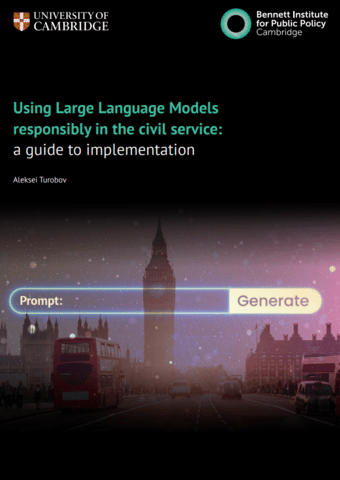
Guide
Using Large Language Models responsibly in the civil service: a guide to implementation
This guidance primarily focuses on civil service policy development, analysis and administrative functions in the UK. It establishes crucial foundations about Large Language Model (LLM) capabilities and limitations, directly informing the practical frameworks and tools provided. It concludes with a practical roadmap for implementing LLMs into civil service operations.
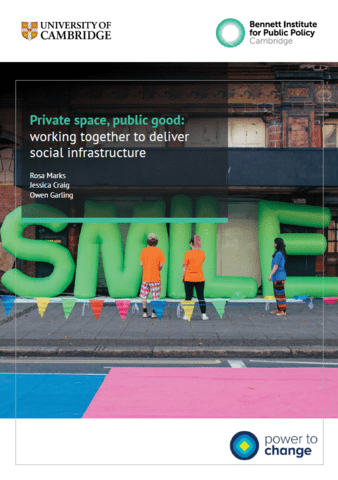
Report
Private space, public good: working together to deliver social infrastructure
Policymakers need to recognise the importance of privately owned social infrastructure and the willingness of many in the private sector to deliver community space. By broadening our understanding of the agents responsible for social infrastructure and highlighting creative approaches to its provision, the report's authors hope to encourage a new model of social infrastructure delivery...

Working paper
Space possibilities for our grandchildren: current and future economic uses of space
We are entering a period where (space) trade frictions are falling, creating new markets. Space as a new economic domain is rapidly expanding, with momentous political, security and economic implications. This new domain of economic competition will generate new opportunities but also open up new challenges requiring policymakers’ focus and action.
Working paper
Using ChatGPT for thematic analysis
ChatGPT has the potential to enhance academic research efficiency and outcomes. Using the GPT (Generative Pre-trained Transformer) model for initial coding in qualitative thematic analysis, the authors of this paper outline the advantages and limitations of using the GPT model and suggest strategies for mitigating risks. The paper includes a comparative discussion on manual versus...
Working paper
The pitfalls of protectionism: import substitution vs. export-oriented industrial policy
With industrial policy comeback and rising protectionism, the authors of this paper explore whether protectionism is still an important policy tool, and if not, which policy tools are available for policy-makers.