

 SHARE
SHARE
Private space, public good: working together to deliver social infrastructure
| Attachment | Size |
|---|---|
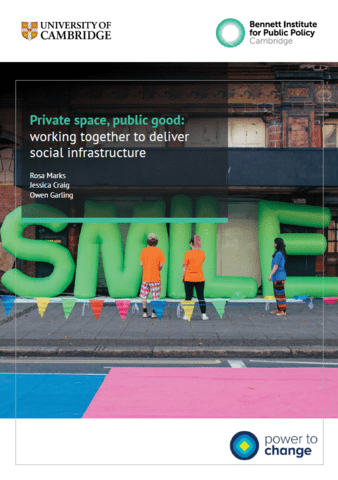
 Private space, public good: working together to deliver social infrastructure Private space, public good: working together to deliver social infrastructure
|
2.45 MB |
Privately-owned spaces can provide considerable civic benefits, and an increasing number of private owners see economic as well as social value in maintaining social infrastructure. As traditional stewardship models become less viable, this report examines the potential for the private sector to contribute more to public placemaking.
Policymakers need to recognise the importance of privately owned social infrastructure and the willingness of many in the private sector to deliver community space. This offers a significant yet underappreciated opportunity for policymakers in the context of increasing financial constraints and the steady decline of social spaces, particularly in poorer communities.
By broadening our understanding of the agents responsible for social infrastructure and highlighting creative approaches to its provision, the report's authors hope to encourage a new model of social infrastructure delivery that foregrounds collaboration and leads to better quality, and better maintained, community spaces.
Four guiding principles for developing and managing social infrastructure are identified:
- establish meaningful partnerships for the development and management of social infrastructure
- adopt a placemaking approach
- develop social infrastructure with sustainability and long-term maintenance in mind, and
- deliver economic and social value through social infrastructure.
