

Person
Don Weatherburn
Affiliation:
Alternate Name:
Donald Weatherburn
ORCID:
Report
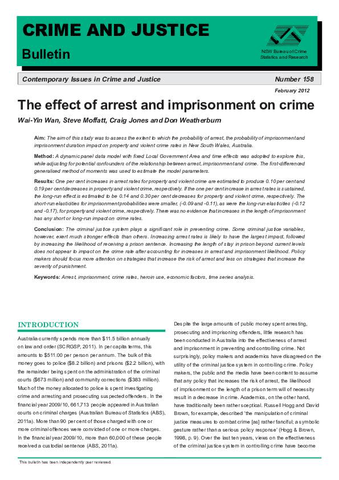
The effect of arrest and imprisonment on crime
This study assesses the extent to which the probability of arrest, the probability of imprisonment and imprisonment duration impact on property and violent crime rates in New South Wales. Method: A dynamic panel data model with fixed Local Government Area and time effects was adopted to explore this, while adjusting for potential confounders of the...
Report
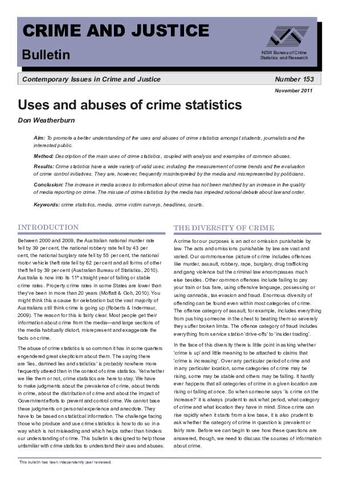
Uses and abuses of crime statistics
Large sections of the media habitually distort, misrepresent and exaggerate the facts on crime, argues this paper.
Fact sheet
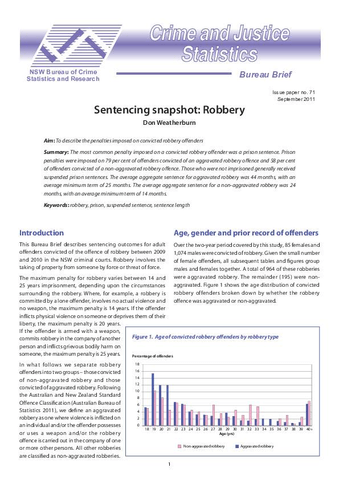
Sentencing snapshot: robbery, 2009-2010
This snapshot describe the penalties imposed on convicted robbery offenders. The most common penalty imposed on a convicted robbery offender was a prison sentence. Prison penalties were imposed on 79 per cent of offenders convicted of an aggravated robbery offence and 58 per cent of offenders convicted of a non-aggravated robbery offence. Those who were...
Report
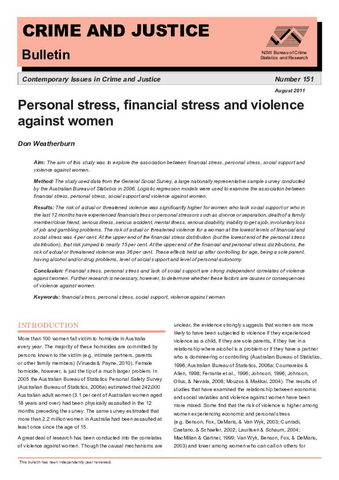
Personal stress, financial stress and violence against women
This study explores the association between financial stress, personal stress, social support and violence against women. Method: The study used data from the General Social Survey, a large nationally representative sample survey conducted by the Australian Bureau of Statistics in 2006. Logistic regression models were used to examine the association between financial stress, personal stress...
Briefing paper
Why does NSW have a higher imprisonment rate than Victoria?
The NSW imprisonment rate is about twice that of Victoria: this bulletin examines the influence of sentencing practice and other factors on the difference between NSW and Victoria in their imprisonment rates. The NSW imprisonment rate is about twice that of Victoria (204 per 100,000 population vs. 104 per 100,000 population) (Australian Bureau of Statistics...