

Cultural safety
Alternative labels
Cultural competency
Description
A policy of ensuring respect for cultural and social differences in the provision of services.
Cultural safety demands actions that recognise, respect and nurture the unique cultural identity of a person and safely meets their needs, expectations and rights. (SafeWork NSW).
Guide
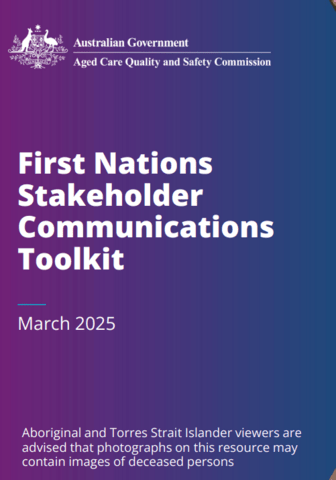
First Nations stakeholder communications toolkit
A toolkit for providers, workers and others involved in providing aged care services for First Nations people. It includes resources, information, and guidance to communicate, engage, and support First Nations communities in understanding aged care system changes. The toolkit empowers stakeholders to lead informed conversations and promote the delivery of culturally safe, quality aged care...
Journal article
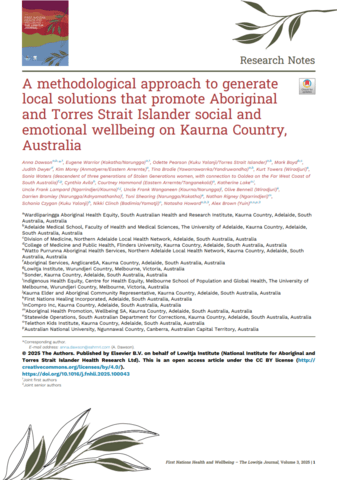
A methodological approach to generate local solutions that promote Aboriginal and Torres Strait Islander social and emotional wellbeing on Kaurna Country, Australia
This article describes a research approach where principles of Indigenous methodology guide application of implementation science methods to generate, implement and evaluate local solutions from the perspectives of Aboriginal and Torres Strait Islander peoples. The co-design phase collected critical insights regarding community needs, challenges and service gaps, and identified shortfalls in local strategic policy.
Guide
Quality practice elements for men’s behaviour change programs (MBCPs) in the Northern Territory
A practice guide for people funding, designing and delivering men’s behaviour change programs, and those working more broadly to enhance community safety and wellbeing. It focuses on how to lift the overall quality of these programs and draws together existing practice standards, recent research and emerging practice-based knowledge, contextualised for the Northern Territory.
Briefing paper
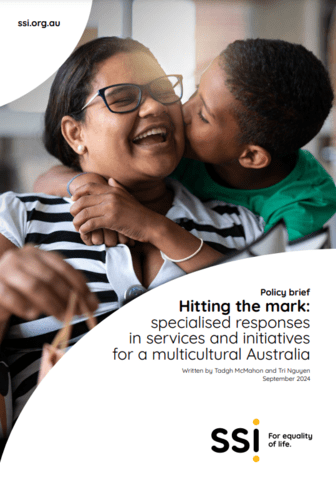
Hitting the mark: specialised responses in services and initiatives for a multicultural Australia (September 2024)
Too often, differences in access and outcomes persist for people from migrant and refugee backgrounds. These disparities are magnified by service responses that inadequately meet their needs and preferences, perpetuating the structural inequalities they already face. This policy brief explores specialised services and initiatives for a multicultural Australia.
Evaluation
Evaluation of the Custody Notifications Service
The Custody Notification Service (CNS) provides independent, culturally-appropriate, telephone-based health, wellbeing and legal support to Aboriginal and Torres Strait Islander people entering police custody. A mixed-methods, theory-based evaluation assessed the service's design, implementation, effectiveness, resource efficiency and community benefits, making recommendations to strengthen the implementation and delivery of the CNS.