

Walkability
Alternative labels
Pedestrian movement
Conference paper
Development and trial of an automated, open source walkability tool through AURIN's Open Source Portal
Creating walkable environments produces a range of health and environmental co-benefits including increased physical activity, social interaction, sustainable living and environmental protection. This paper provides details of the development, trial, validation and potential application of a ‘Walkability Index Tool’.

Conference paper
Four dimensions of neighbourhood form related to children's walks to school
The disciplines of town planning and public health have investigated the connection between walking and neighbourhood form. In particular, Terri Pikora and her colleagues (2003) created a schema to classify a range of potential elements that may influence an adult’s decision to walk.
Conference paper
Promoting active transport to school in suburban Melbourne: understanding problems with politics and process
The paper examines actor behaviour and institutional cultures in the processes of Active Transport to School (ATS) policy implementation in local government through an investigation of the Cities of Glen Eira and Boroondara, two middle-ring Melbourne council areas with quite different ATS outcomes.
Conference paper
Improving pedestrian access at arterial roads
A critical building block of a functional successful city is the presence of vibrant streets; streets that encourage walking. Physical barriers such as rivers, freeways and even railway lines are well recognised as impeding levels of walking activity. The barrier effect is the focus of this paper
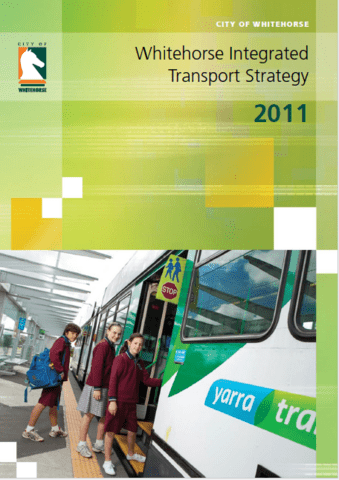
Strategy
Whitehorse Integrated Transport Strategy 2011
This strategy document creates a framework to consider the different modes of transport available to the Whitehorse community and provides direction to facilitate travel options and networks that are sustainable, convenient, accessible and safe.