

Children
Alternative labels
Childhood

Briefing paper
Promoting mental health in a changing climate: children and young people as a priority population group
Climate change-related concerns in children and young people are amplified by climate change related misinformation on social media. Therefore, the authors of this paper argue that programs that promote children’s and young people’s mental wellbeing, including appropriate resourcing for schools, and national evidence-based guidelines on climate change misinformation, must be developed.
Report
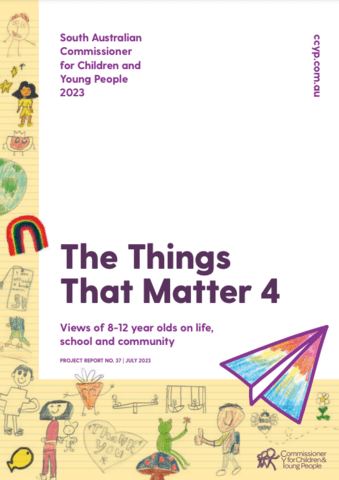
The Things That Matter 4: views of 8-12 year olds on life, school and the community
This fourth Things That Matter report draws on responses from school children aged 8–12 years who participate in the South Australia’s Commissioner for Children and Young People's annual Student Voice Postcards initiative via their school.

Report
Safe and sound: views and experiences of young people on public transport
In preparing this report 1,124 South Australian young people aged 13 to 20 years participated in a survey about their experiences using public transport. The three major challenges young people face in relation to public transport are its cost, accessibility and safety.

Report
“It should be easier to just exist”: how children and young people are impacted by and responding to the rising cost of living in NSW
The rising cost of living has been a core concern across government, media, and among communities for several years. It has also been an increasing concern for children and young people. This report presents interim findings, as part of a broader piece of work ACYP is conducting with young people across New South Wales.
Working paper
Family size and domestic violence in a high-fertility society
Does family size affect the prevalence of domestic violence? Using nationally representative survey data from Samoa, which has among the world’s highest fertility rates, the author extends the classic work on child quantity-quality trade-offs to also consider domestic violence.