

Child abuse
Research Summary
The Australian Child Maltreatment Study shows a large proportion of Australians experience maltreatment as children
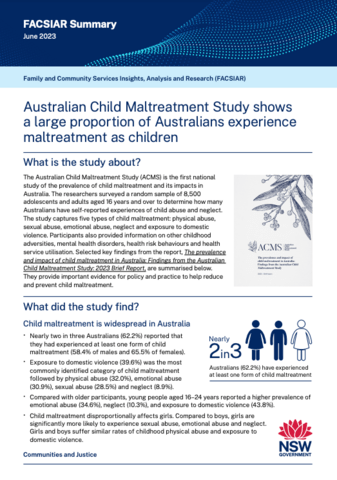
This publication reports key findings from the new Australian Child Maltreatment Study. The findings show that child maltreatment is very widespread in Australia.

Evaluation
Understanding the social impact of safeguarding services for children and young people
Safeguarding Services is a suite of support services offered to organisations who deliver services to children and young people. The Centre for Social Impact at the University at the Western Australia was engaged by the Australian Childhood Foundation to examine and document the social impact story of Safeguarding Services. This report outlines the findings.

Report
The overlap between child sexual abuse live streaming, contact abuse and other forms of child exploitation
The authors of this report analysed the chat logs of seven Australia-based men who had committed 145 child sexual abuse (CSA) live streaming offences, to examine the overlap between this offending, contact sexual offending and engagement with child sexual abuse material (CSAM).

Report
The prevalence and impact of child maltreatment in Australia: findings from the Australian Child Maltreatment Study
The Australian Child Maltreatment Study randomly surveyed 8503 randomly selected Australians (aged 16-65+). The researchers then generated the first, nationally representative rates of all five types of child maltreatment (physical abuse, sexual abuse, emotional abuse, neglect, and exposure to domestic violence) and their associated outcomes in Australia. The findings underscore the moral and economic imperative...
Journal article
The prevalence and nature of multi-type child maltreatment in Australia
The objective of this study was to determine the prevalence in Australia of multi-type child maltreatment, defined as two or more maltreatment types (physical abuse, sexual abuse, emotional abuse, neglect, or exposure to domestic violence) and to examine its nature, family risk factors, and gender and age cohort differences.