

Perpetrator interventions
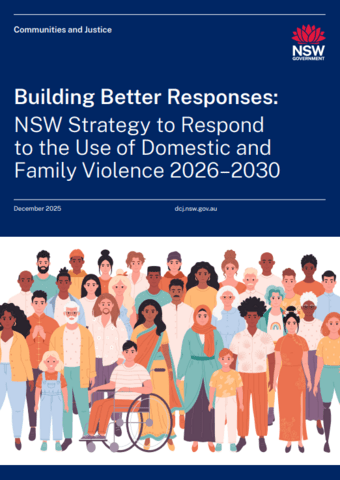
Strategy
Building better responses: NSW strategy to respond to the use of domestic and family violence 2026–2030
A dedicated strategy for New South Wales (NSW) to respond to the use of domestic and family violence and address perpetrator behaviour. The strategy provides a focus on people who use violence. It recognises that tackling key drivers of violence early is one of the most effective ways to break cycles of violence and protect...

Submission
Seizing a unique opportunity to improve responses to men using domestic and family violence
This submission outlines the investment needed to implement the NSW Strategy to respond to the use of domestic and family violence 2026-2030. The submission presents a roadmap for building earlier, more coordinated and more effective responses to men using violence, a critical step toward improving safety for women and children across New South Wales.
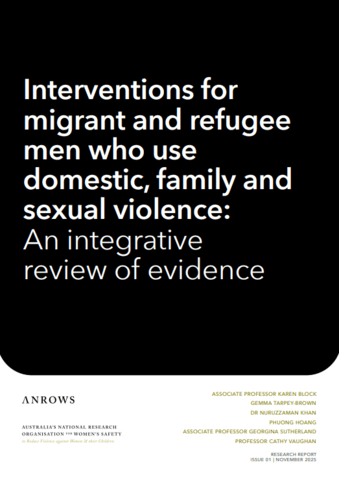
Literature review
Interventions for migrant and refugee men who use domestic, family and sexual violence
For migrant and refugee families in Australia, domestic, family and sexual violence (DFSV) is perpetrated within the context of complex social factors. This review presents an analysis of current knowledge on interventions for migrant and refugee men who have used DFSV. It identifies best practice principles, programs and models relevant to implementation in Australia.

Submission
Victoria’s community safety story: stop violence at its source
Most recent statistics show Victoria is responding to men using violence too late and victim-survivors bear the brunt of this inaction. A comprehensive, integrated approach to stopping violence at its source is urgently needed. Victoria needs to do much more, much earlier. This submission outlines recommendations for the Victorian Budget.
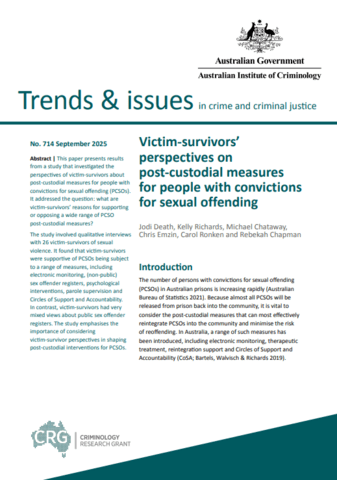
Report
Victim-survivors' perspectives on post-custodial measures for people with convictions for sexual offending
This paper presents results from an Australian study that investigated the perspectives of victim-survivors about post-custodial measures for people with convictions for sexual offending (PCSOs). It addressed victim-survivors’ reasons for supporting or opposing a wide range of PCSO post-custodial measures. The study emphasises the importance of considering victim-survivor perspectives in shaping post-custodial interventions for PCSOs.