

Family services
Alternative labels
Family support services
Family support
Report
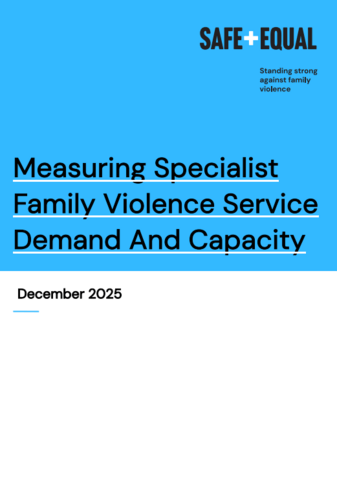
Measuring specialist family violence service demand and capacity
This report provides analysis and insights on data collected through Safe and Equal’s 2025 Demand and Capacity survey for Victoria. The data collection is focused on gathering an overall picture of demand for specialist family violence services and case management support. The report finds services are operating and directing resources mostly towards crisis response.
Guide
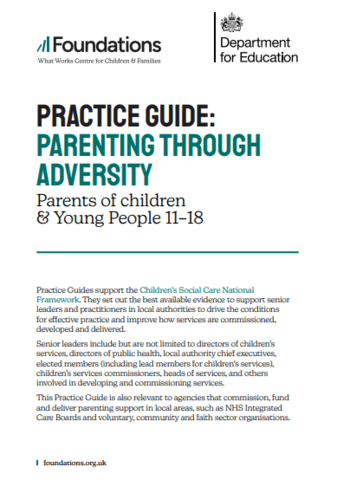
Practice guide: parenting through adversity
This practice guide focuses on parenting support for families experiencing adversities who have at least one child or young person aged 11 to 18 years old. The guide sets out key principles and recommendations for evidence-based parenting support in the United Kingdom. It recommends evidence-based parenting programs across two types: family therapy interventions and parent...
Journal article
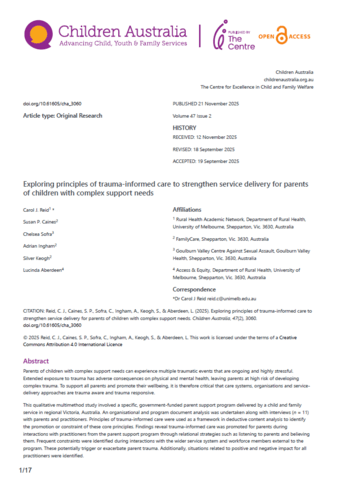
Exploring principles of trauma-informed care to strengthen service delivery for parents of children with complex support needs
This study examines a regional Victorian parent support program to understand how trauma‑informed care was enabled or limited for parents of children with complex support needs. The findings highlight the need for clearer organisational policies, stronger workforce training, collaboration with trauma‑specific services and ongoing consultation with parents.
Literature review
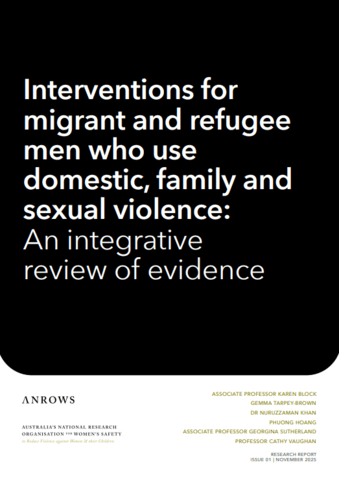
Interventions for migrant and refugee men who use domestic, family and sexual violence
For migrant and refugee families in Australia, domestic, family and sexual violence (DFSV) is perpetrated within the context of complex social factors. This review presents an analysis of current knowledge on interventions for migrant and refugee men who have used DFSV. It identifies best practice principles, programs and models relevant to implementation in Australia.
Briefing paper
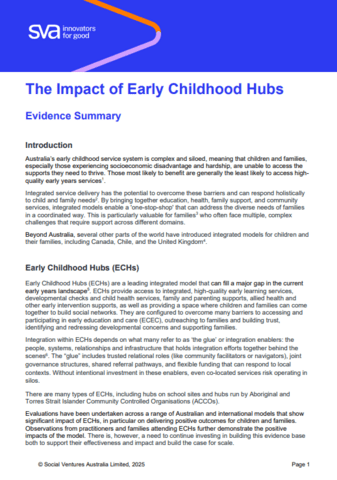
The impact of Early Childhood Hubs: evidence summary
Early Childhood Hubs (ECHs) are a leading integrated model that can fill a major gap in the current early years landscape. ECHs are configured to overcome many barriers to accessing and participating in early education and care. This brief provides an overview of the key findings related to the efficacy of ECHs.