

Humanities Arts and Social Science (HASS)
Alternative labels
HASS

Strategy
Framework for the governance of Indigenous data: Humanities, Arts and Social Sciences and Indigenous Research Data Commons
This framework has been developed to guide ethical, inclusive and culturally grounded data practices across the Humanities, Arts, Social Sciences and Indigenous Research Data Commons. The framework recognises that all data, whether held by governments, institutions or communities, must be governed in ways that respect Indigenous rights, laws and relational worldviews.
Article
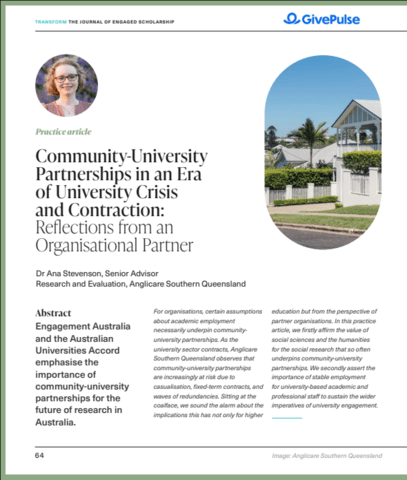
Community-university partnerships in an era of university crisis and contraction
The Australian Universities Accord highlights the need for strong community-university partnerships to advance research. This article stresses the role of social sciences and humanities in underpinning such collaborations and calls for secure employment for academic and professional staff, ensuring universities can sustain meaningful engagement and fulfill broader societal responsibilities.
Discussion paper
Liberal arts and classical education: a return to beauty
Schooling in the tradition of the liberal arts is one of the most dynamic areas of inquiry and exploration in education. This paper explores its antecedents, notes the heightened activity taking place abroad and considers the consonance of the liberal arts tradition with Australian schools in the context of a mandated curriculum.
Position paper
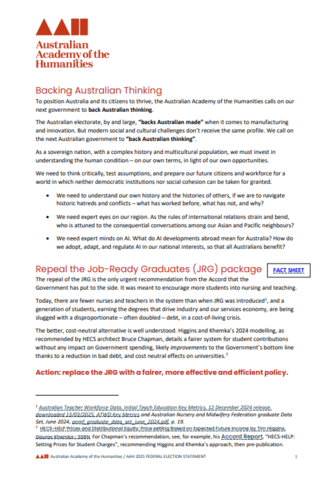
Back Australian thinking
This paper calls on the next government to back Australian thinking, to invest in understanding the human condition. It contains three calls to action to position future citizens and the workforce for a world in which neither democratic institutions nor social cohesion can be taken for granted.
Guide
A little book of creative methods for social inquiry and research communication
This booklet provides an overview of 13 creative approaches applied to recent research projects. Using creative methods for social inquiry can spark new ways of engaging in futures thinking and are valuable for communicating research findings to the public in engaging and accessible ways.