

Intelligence organisations
Alternative labels
ASIO
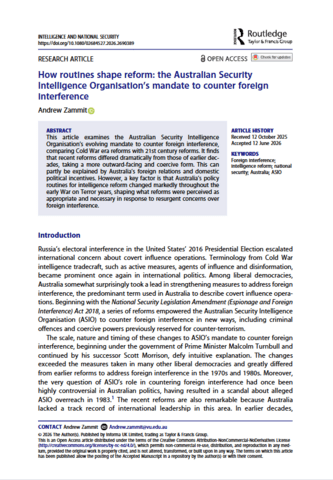
Journal article
How routines shape reform: the Australian Security Intelligence Organisation’s mandate to counter foreign interference
This article examines the Australian Security Intelligence Organisation’s evolving mandate to counter foreign interference, comparing Cold War era reforms with 21st century reforms. It finds that recent reforms differed dramatically from those of earlier decades, taking a more outward-facing and coercive form.
Report
Match-fit for the global contest? Innovation, leadership, culture and the future of Australia’s national intelligence community
The business model of the Australian national intelligence community (NIC) is being challenged. In 2025, technology is the centre of gravity of national power, not just military might. Informed by stakeholder engagement, this report finds there’s much more that can be done when it comes to the NIC and innovation. The report makes five key...
Report
2024 Independent intelligence review
A review conducted to ensure Australia's intelligence agencies are best positioned to continue to serve the national interest. It found a need for deeper integration of intelligence with other arms of government. The review provides 67 recommendations including investing in further capability to ensure the intelligence community maintains its high performance.
Report
Independent review of the Australian Criminal Intelligence Commission and associated Commonwealth law enforcement arrangements
This first principles review assessed the operation and effectiveness of the Australian Criminal Intelligence Commission (ACIC) as Australia’s national criminal intelligence agency. The review found that comprehensive reform would be necessary for ACIC to combat the threat posed by serious and organised crime. The Government has agreed or agreed in-principle with 27 of the 29...
Report
The ‘official’ histories of Australian and British intelligence: lessons learned and next steps
This report outlines the challenges experienced in writing Australia’s and the UK’s official intelligence histories to date. It identifies why and how such histories are valuable for explaining and building the social licence for the work of intelligence agencies and advancing historical scholarship on an important but previously obscured element of democratic statecraft.