

Report
Report
Voluntary assisted dying in the Northern Territory
The final report from an inquiry into voluntary assisted dying (VAD) in the Northern Territory (NT). VAD is not currently legal in the NT. The report recommends that VAD legislation be adopted. It contains the Committee’s 86 recommendations including drafting instructions. A series of guiding principles are recommended to be reflected in the VAD legislation.
Report
Voluntary assisted dying in residential aged care homes: September 2025
This report is about residential aged care and information provided about the legal choice of voluntary assisted dying (VAD). Despite VAD being legal in every state and the ACT, the report finds that the majority of Australia’s residential aged care providers are yet to give VAD the same support and visibility as other end-of-life choices.
Report
Regional perspectives research project: phase 2 summary report
The Regional Perspectives Project was about listening to, and learning from, Pacific people on a range of topics that reflect Pacific priorities, including relationships with other countries. This report presents a summary of the key findings from Phase 2 of the research undertaken in Solomon Islands and Vanuatu.
Report
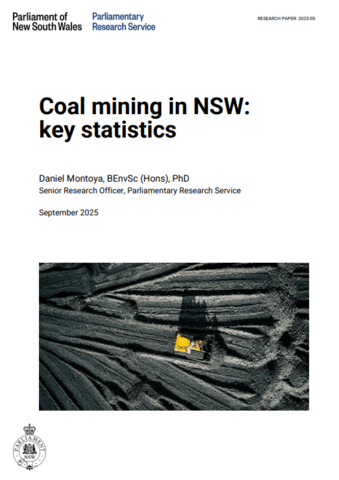
Coal mining in NSW: key statistics
This paper identifies all coal mines in New South Wales (NSW) which are operational or could become operational in future, and their current and proposed timeframes of operation. It also sets out key economic statistics on employment, production, exports and royalties. NSW has 35 operational coal mines located across the five major NSW coalfields.
Report
Economic security in retirement: how life events affect older Australian women
This report shows how Australian women’s economic security in retirement is often shaped by life events such as separation, informal care demands and family violence that can set women back financially. It proposes that with the right policy settings, gender gaps can be addressed to put more women on track for economic security in retirement.