

Journal
Policy Quarterly
Affiliated organisation:
Journal URL:
ISSN:
2324-1101

Journal article
Towards a Regionally Responsive Network: implementation challenges in New Zealand’s reforms to vocational education
New Zealand has been undertaking major reform of its vocational education sector since 2019. The authors of this article suggest that collectively, greater focus is needed on understanding and responding to specific learner needs within regions and enabling learners to continue learning over their lifetime.

Journal article
Wage policy and justice in Aotearoa New Zealand: young adults' perspectives
Young people are often framed as being underrepresented and/or insufficiently considered in decision-making processes, including public policy. To help remedy the lack of youth voices in New Zealand government policy, the authors of this article present the first results from the 'What Is Your Stand?' research project. The article presents and discusses the results specifically...
Journal article
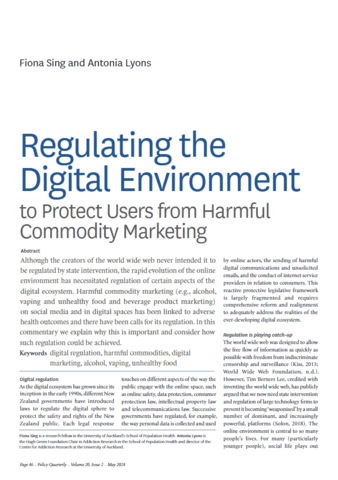
Regulating the digital environment to protect users from harmful commodity marketing
Harmful commodity marketing (e.g: alcohol, vaping and unhealthy food and beverage products) in digital spaces has been linked to adverse health outcomes and there have been calls for its regulation. This article explains why this is important and considers how such regulation could be achieved.

Journal article
Regulatory stewardship: the challenge of joining a virtue and a mechanism
This article explores the challenges New Zealand’s regulatory agencies face in operationalising regulatory stewardship, and provides some conceptual clarity that may aid these agencies in collaborating to develop and adopt the whole-of-system, life cycle view of regulation that is envisaged.

Journal article
Enhancing long-term governance: Parliament’s vital oversight role
This article explores how the New Zealand Parliament scrutinises the quality of long-term governance and considers how such scrutiny could be made more systematic, proactive and rigorous.