

First Peoples
Aboriginal and Torres Strait Islander peoples should be aware that this resource may contain images or names of people who have since passed away.
 SHARE
SHARE
Evidence on optimal hours of ECEC for Aboriginal and Torres Strait Islander children
| Attachment | Size |
|---|---|
 Evidence on optimal hours of ECEC for Aboriginal and Torres Strait Islander children Evidence on optimal hours of ECEC for Aboriginal and Torres Strait Islander children
|
778.57 KB |
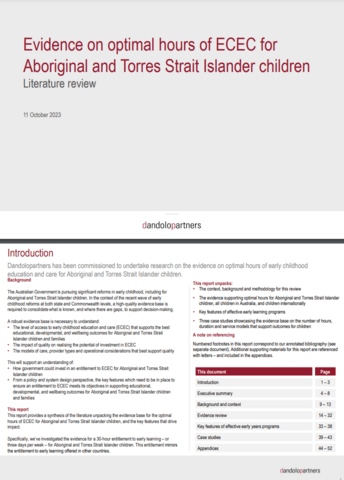
This report provides a synthesis of the literature unpacking the evidence base for the optimal hours of ECEC for Aboriginal and Torres Strait Islander children, and the key features that drive impact. Specifically, it investigates the evidence for a 30-hour entitlement to early learning – or three days per week – for Aboriginal and Torres Strait Islander children. This entitlement mirrors the entitlement to early learning offered in other countries.
Context
The Australian Government is pursuing significant reforms in early childhood, including for Aboriginal and Torres Strait Islander children. In the context of the recent wave of early childhood reforms at both state and Commonwealth levels, a high-quality evidence base is required to consolidate what is known, and where there are gaps, to support decision-making.
A robust evidence base is necessary to understand:
• The level of access to early childhood education and care (ECEC) that supports the best educational, developmental, and wellbeing outcomes for Aboriginal and Torres Strait Islander children and families
• The impact of quality on realising the potential of investment in ECEC
• The models of care, provider types and operational considerations that best support quality
This will support an understanding of:
• How government could invest in an entitlement to ECEC for Aboriginal and Torres Strait Islander children
• From a policy and system design perspective, the key features which need to be in place to ensure an entitlement to ECEC meets its objectives in supporting educational, developmental, and wellbeing outcomes for Aboriginal and Torres Strait Islander children and families
This report unpacks:
• The context, background and methodology for this review
• The evidence supporting optimal hours for Aboriginal and Torres Strait Islander children, all children in Australia, and children internationally
• Key features of effective early learning programs
• Three case studies showcasing the evidence base on the number of hours, duration and service models that support outcomes for children
