

 SHARE
SHARE
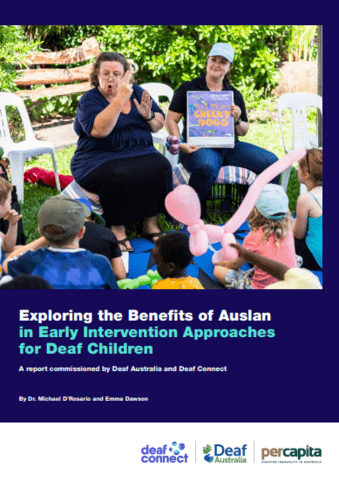
Exploring the benefits of Auslan in early intervention approaches for deaf children
| Attachment | Size |
|---|---|
 Exploring the benefits of Auslan in early intervention approaches for deaf children Exploring the benefits of Auslan in early intervention approaches for deaf children
|
914.52 KB |
While the benefits of sign language are readily apparent, the role of the timing of language intervention, and early intervention are not readily apparent to many who do not possess a thorough understanding of the benefits of such intervention and the process of language acquisition. The decision to support sign language as the first language for a deaf child is a complex one for parents, given that most deaf children are born into hearing families. Nonetheless, the nearly half century’s worth of research supports the role of sign language in early intervention.
This report considers the economic benefits of Auslan accounting for the critical benefits to wellbeing, health literacy, services access and the productivity of the economy. The research seeks to account for the benefits associated with Auslan as a community-enabling and culturally supportive language.
The benefits of early intervention appear to be readily apparent where a child is profoundly deaf, and potentially beneficial to hard of hearing children who possess insufficient hearing capability to benefit from an exclusively oral modal of education. Bimodal bilingualism is a highly beneficial intervention for many children, and Auslan should not be presented as a last resort option given the compelling evidence supporting its role as an early intervention strategy in support of first language acquisition and cognitive development.
The critical period for language acquisition is a critical intervention window for deaf children and acknowledging the importance of the earliest plausible intervention and its lifetime benefits to the recipient is critical to developing a credible evidence-based approach to this issue set at a national level.
This is one of three ground-breaking reports on the economic impact of Auslan on the Australian Economy.
