

 SHARE
SHARE
Migration Amendment Bill 2024: bill digest

Introduced to the House of Representatives on 7 November 2024, the Bill amends the Migration Act 1958 to introduce new measures for removing certain non-citizens from Australia. The Migration Amendment Bill 2024 aims to respond to two High Court decisions that found certain immigration detention practices unconstitutional. The Digest outlines the Bill’s key provisions, the background leading to its introduction, and potential legal and human rights concerns raised by commentators.
The Bill is presented in the context of ongoing debate surrounding Australia's immigration detention policies, specifically regarding the constitutionality of indefinite detention and the use of electronic monitoring and curfews for certain visa holders. The Bill attempts to address these issues by providing a framework for third-country reception arrangements and redefining the criteria for imposing monitoring conditions. However, concerns remain about the potential for human rights violations and the breadth of powers granted to the government under the proposed legislation.
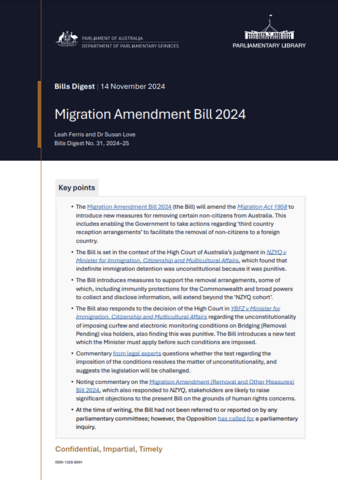
Key points
- The Bill is set in the context of the High Court of Australia’s judgment in NZYQ v Minister for Immigration, Citizenship and Multicultural Affairs, which found that indefinite immigration detention was unconstitutional because it was punitive.
- The Bill introduces measures to support the removal arrangements, some of which, including immunity protections for the Commonwealth and broad powers to collect and disclose information, will extend beyond the ‘NZYQ cohort’.
- The Bill also responds to the decision of the High Court in YBFZ v Minister for Immigration, Citizenship and Multicultural Affairs regarding the unconstitutionality of imposing curfew and electronic monitoring conditions on Bridging (Removal
Pending) visa holders, also finding this was punitive. - The Bill introduces a new test which the Minister must apply before such conditions are imposed.
