

 SHARE
SHARE
Billions in the bush: renewable energy for regional prosperity

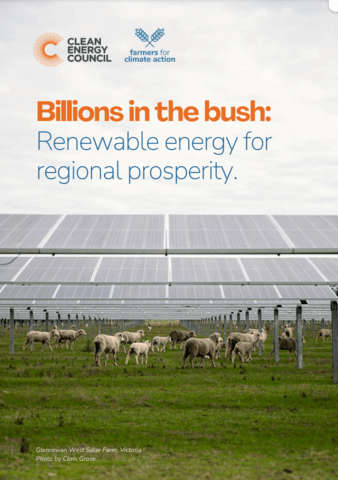
Large-scale renewable energy projects are estimated to deliver $1 billion to farmers by 2030, according to this report. The report looks at the growth in direct payment to host landholders as well as contributions to community funds, arguing that the substantial and stable income from these projects makes renewable energy a once in a generation economic opportunity for regional Australia.
Host landholders are paid an annual fee by developers over a multi-decade timeframe (typically 25-30 years). These payments are made regardless of how much electricity is generated, providing a reliable revenue stream even during drought, poor harvests or downturns in commodity markets. The report argues that through these payments, as well as contributions to community benefit funds, renewables are establishing sustainable alternative income streams for struggling regional communities.
Findings
- The share of renewable energy across the National Electricity Market (NEM) is now more than 40%.
- Large-scale wind and solar projects across the NEM are expected to deliver $7.7 billion-9.7 billion in direct payments to landholders between 2024 and 2050.
- In the same period, large-scale wind and solar projects will deliver $1.9 billion in contributions to regional communities and councils.
- Farmers can earn $38,500 to $45,500 per year from hosting a typical 7MW turbine and up to $1,250 per hectare from solar.
- Large-scale solar and wind projects across the NEM could result in a value-added contribution to GDP of more than $25 billion by 2030.
- Including flow-on supply chain and consumption effects, the total national economic output from this renewable energy investment would be over $68 billion.
