

Sensitivity Warning
First Peoples
Aboriginal and Torres Strait Islander peoples should be aware that this resource may contain images or names of people who have since passed away.
Briefing paper
 SHARE
SHARE
Ear and hearing health of Aboriginal and Torres Strait Islander people 2024: children aged 0–14
Publisher
Hearing impairment
Aboriginal people (Australia)
First Peoples health
Torres Strait Islander people
First Nations children
Australia
Resources
| Attachment | Size |
|---|---|
 Ear and hearing health of Aboriginal and Torres Strait Islander people 2024: children aged 0–14 Ear and hearing health of Aboriginal and Torres Strait Islander people 2024: children aged 0–14
|
1.86 MB |
Description
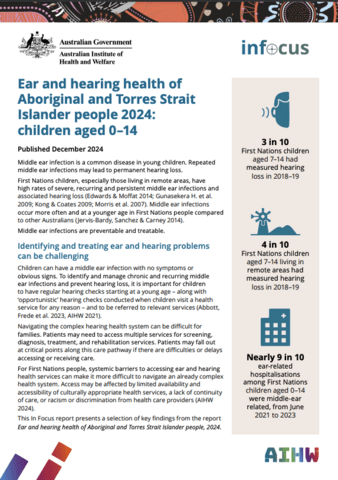
This paper presents information on the ear and hearing health of First Nations children aged 0–14. It shows preventable hearing loss among First Nations children is dropping, but still well above national averages.
Middle ear infection is a common disease in young children. Although it is both treatable and preventable, repeated middle ear infections may lead to permanent hearing loss. First Nations children, especially those living in remote areas, have high rates of severe, recurring and persistent middle ear infections and associated hearing loss.
Findings
- 3 in 10 First Nations children aged 7–14 had measured hearing loss in 2018–19 and this increased to 4 in 10 for First Nations children aged 7–14 living in remote areas.
- Nearly 9 in 10 ear-related hospitalisations among First Nations children aged 0–14 were middle-ear related, from June 2021 to 2023.
- The proportion of reported ear and hearing problems among First Nations children aged 0–14 fell from 11% in 2001 to around 7% (19,100 children) in 2018–19.
- In 2018–19, an estimated 29% of First Nations children aged 7–14 (42,200 children) had hearing loss.
Publication Details
DOI:
10.25816/89e2-dd02
ISBN:
978-1-923272-38-5
Copyright:
Commonwealth of Australia 2024
License type:
CC BY
Access Rights Type:
open
Post date:
5 Dec 2024
