

Guide
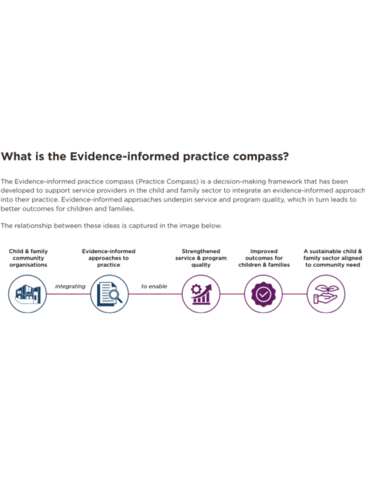
Evidence-informed practice compass
The evidence‑informed practice compass is a practical decision‑making framework that helps child and family service organisations embed evidence‑informed approaches into their everyday work. It sets out the core domains that underpin high‑quality practice and supports teams to reflect on what they currently do and identify where improvements are needed.
Literature review
Aboriginal and Torres Strait Islander Family-Led Decision Making
This review describes the evidence base on Aboriginal and Torres Strait Islander Family-Led Decision Making (AFLDM), a rights-based approach that can strengthen participation and improve outcomes. AFLDM supports decisions about children’s safety within the statutory child protection system. The review covers what the evidence shows, gaps, what good practice looks like and learning and evaluation...
Strategy
The national child and family investment strategy
The strategy focuses on driving the shift towards earlier supports and the transition towards the Aboriginal Community-Controlled Organisation (ACCO) sector. The strategy shows how all governments will prioritise funding to child and family services. The goal is to support all families to provide safe and caring homes for their children.
Strategy
SNAICC sector transformation: principles framework
The framework provides a roadmap for mainstream organisations to transition out-of-home care services to Aboriginal Community Controlled Organisations, placing self-determination, cultural authority and community control at the centre of child and family services. The aim is to ensure Aboriginal and Torres Strait Islander communities design, govern and control the services that impact their children and...
Report
Waterways project report
The report details the impact of the nationally delivered, culturally responsive trauma informed training initiative Project Waterways, highlighting how the co-design approach strengthened the Aboriginal Community-Controlled Organisations sector, increased workforce capability to respond to intergenerational trauma and drove progress towards the National Agreement on Closing the Gap Target 12.