

Organisation
The Victorian Collaborative Centre for Mental Health and Wellbeing
Owning Institution:
Guide
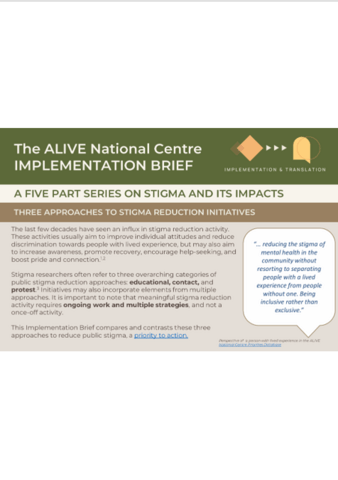
Three approaches to stigma reduction initiatives
This guide compares and contrasts three overarching categories of public stigma reduction approaches – educational, contact-based and protest-based – outlining what each involves, examples of each in practice, key considerations, and lived experience perspectives on their strengths and limitations.
Briefing paper
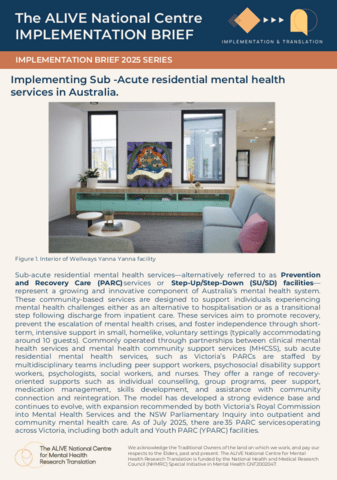
Implementing sub-acute residential mental health services in Australia
This brief examines sub-acute residential mental health services as a growing and evidence-based component of Australia's mental health system. It summarises Australian and international research evidence on service effectiveness, consumer and carer experiences, scalability modelling, and implementation challenges.
Briefing paper
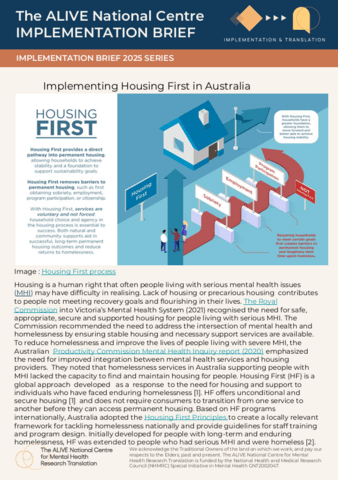
Implementing Housing First in Australia
This brief examines the Housing First approach for people living with serious mental health issues who are experiencing homelessness. It outlines the evidence base for Housing First, implementation research including lived experience perspectives, scalability considerations, and practical guidelines across systems, community, service, and individual levels for implementing Housing First in the Australian context.
Evaluation
Trauma-informed practice implementation pilot project in Victoria’s mental health and wellbeing services
The Trauma-informed Practice Capability Pilot Project was conducted across three Victorian mental health and wellbeing services. This report provides an evaluation of the pilot, including findings relevant to consumers, families, carers, supporters and kin, practitioners and service leaders. The report provides recommendations for government and for mental health and wellbeing services.
Strategy
Translational research strategy 2024-2027
The strategy embeds collaboration between researchers, mental health practitioners and people with lived and living experiences in care settings to improve outcomes for consumers, carers, family, supporters and kin. It is comprised of four key elements: strategic goals, focus area, work and enabling pillars, and implementation principles.