

Organisation
Parliamentary Library (Australia)
Owning Institution:
Briefing paper
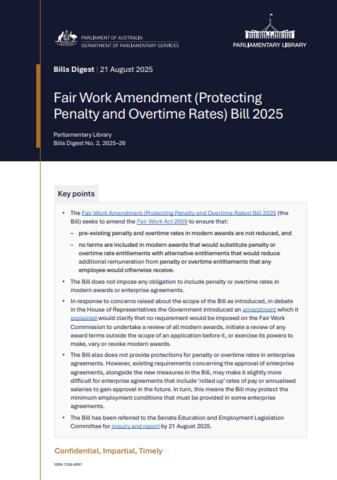
Fair Work Amendment (Protecting Penalty and Overtime Rates) Bill 2025: bill digest
The Fair Work Amendment (Protecting Penalty and Overtime Rates) Bill 2025 seeks to amend the Fair Work Act 2009 to ensure that pre-existing penalty and overtime rates in modern awards are not reduced. This paper provides an overview of penalty and overtime rates in Australia, presents key issues and provisions, and summarises the position of...
Briefing paper
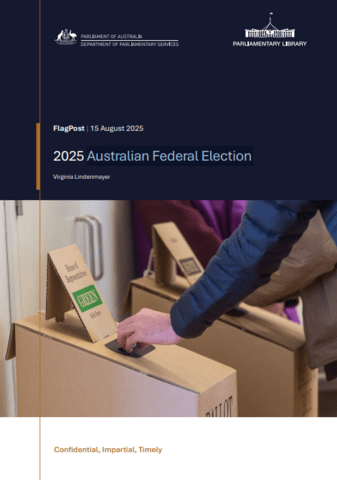
2025 Australian federal election
This paper provides an overview of the 2025 Australian federal election, including electoral trends and results. It presents a summary of the election timelines, candidates, voter participation and close seats. At the close of rolls, there was a record enrolment rate of 98%, which is exceptionally high compared to similar democracies.
Briefing paper
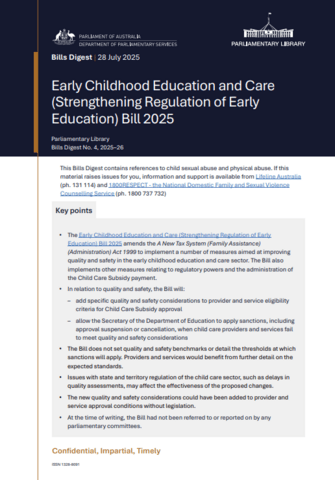
Early Childhood Education and Care (Strengthening Regulation of Early Education) Bill 2025: bill digest
The Early Childhood Education and Care (Strengthening Regulation of Early Education) Bill 2025 amends the A New Tax System (Family Assistance) (Administration) Act 1999 to implement measures aimed at improving quality and safety in the early childhood education and care sector. This paper sets out the purpose of the Bill, the background, government responsibilities, key...
Briefing paper
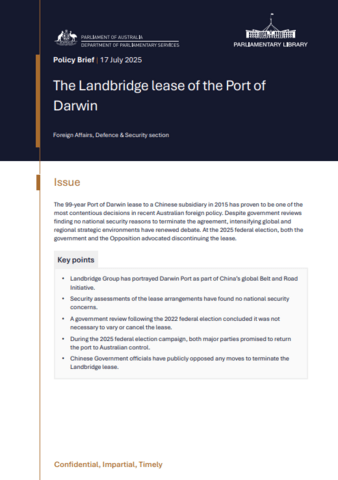
The Landbridge lease of the Port of Darwin
The 99-year Port of Darwin lease to a Chinese subsidiary in 2015 has been one of the most contentious decisions in recent Australian foreign policy. Despite government reviews finding no national security reasons to terminate the agreement, intensifying global and regional strategic environments have renewed debate. This brief outlines the context, continuing doubts and what's...
Briefing paper
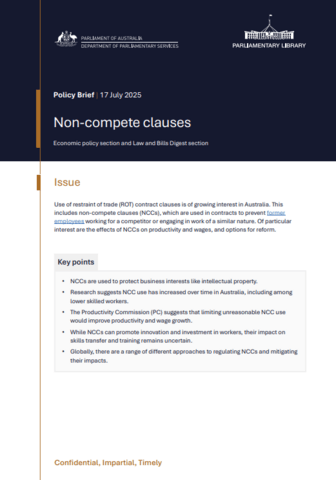
Non-compete clauses
Use of restraint of trade contract clauses is of growing interest in Australia. This includes non-compete clauses (NCCs). Of particular interest are the effects of NCCs on productivity and wages, and options for reform. This paper sets out the context, the arguments against NCCs, how other countries have regulated NCCs and the Australian Government's approach.