

Organisation
Lowy Institute for International Policy
Alternate Name:
Lowy Institute
Website:
Report
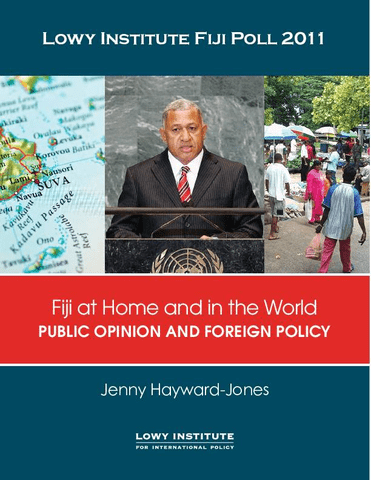
Fiji at home and in the world: public opinion and foreign policy
This wide-ranging survey examines public opinion in Fiji about the performance of Fiji's military-led government and Fiji’s relations with the world. Questions focused on the implementation of government promises, the role of Fiji’s military, and democracy. Foreign policy questions addressed Fiji’s relationships with traditional and newer partners, Fiji’s role in the Pacific, and Fiji’s suspension...
Report
Talib or Taliban? Indonesian students in Pakistan and Yemen
This paper looks at the issue of Indonesian students who study at Islamic educational institutions in Pakistan and Yemen. Its primary goal is to understand whether the presence of Indonesian students at Islamic institutions in Pakistan and Yemen poses a risk, either in terms of radicalisation, or in the formation (or re-formation) of direct contacts...
Report
Diplomatic disrepair: rebuilding Australia's international policy infrastructure
A review of Australia's overseas diplomatic network and a comparison with the foreign services of other developed nations. Three years ago, the Lowy Institute brought together a panel of eminent Australians to review the instruments with which Australia seeks to engage the wider world and shape our international environment in ways favourable to our economic...
Report
Uncharted waters: The US alliance and Australia's new era of strategic uncertainty
Taking Australian public attitudes into perspective, this paper focuses on the current and future challenges facing the Australia-US alliance, with a focus on China's rise. September 2011 marks two important milestones - the tenth anniversary of the devastating 9/11 terrorist attacks and the 60th anniversary of the signing of the ANZUS security treaty during the...
Discussion paper
Improving access to climate financing for the Pacific Islands
The United Nations Framework Convention on Climate Change (UNFCCC) commits developed countries to provide assistance to ‘developing countries that are particularly vulnerable to the adverse effects of climate change in meeting the costs of adaptation.’