

Report
Understanding the relationship between crime victimisation and mental health: a longitudinal analysis of population data
Being a victim of violent crime has a damaging effect on mental health, particularly for women, according to this report. The needs and experiences of victims of crime have become increasingly recognised as an important aspect of criminal justice and public policy. In Australia, victim support services grew from community-based organisations and lobby groups. With...
Report
Personal stress, financial stress, social support and women’s experiences of physical violence: a longitudinal analysis
This study aimed to determine whether higher levels of personal and financial stress and/or lower levels of social support at one point in time are associated with a higher risk of experiencing physical violence at a later point in time. Method: Logistic generalized estimating equations (GEE) and fixed effects modelling were used to examine the...
Report
Police use of court alternatives for young persons in NSW
This study measured the level of variation across the NSW Police Force’s Local Area Commands (LACs) in the proportion of young persons diverted from court, before and after adjusting for factors police may consider when deciding how to proceed against a young person. Method: Between July 2010 and June 2011, for each LAC in NSW...
Report
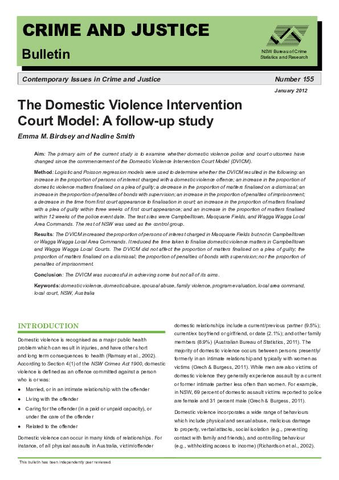
The Domestic Violence Intervention Court Model: a follow-up study
The Domestic Violence Intervention Court Model was successful in achieving some but not all of its aims. This study examines whether domestic violence police and court outcomes have changed since the commencement of the Domestic Violence Intervention Court Model (DVICM). Method: Logistic and Poisson regression models were used to determine whether the DVICM resulted in...
Report
Why is the juvenile re-offending rate higher than expected?
Research by the NSW Bureau of Crime Statistics and Research has shown that the observed rate of re-offending among juvenile offenders convicted in 2006/7 was significantly higher than the predicted rate of re-offending. The discrepancy, though small, (57.9% observed rate compared to 54.7% predicted rate) was statistically significant. The re-offending predictions were made using an...