

Labour force productivity
Alternative labels
Labor productivity
Workforce productivity
Worker productivity
Briefing paper
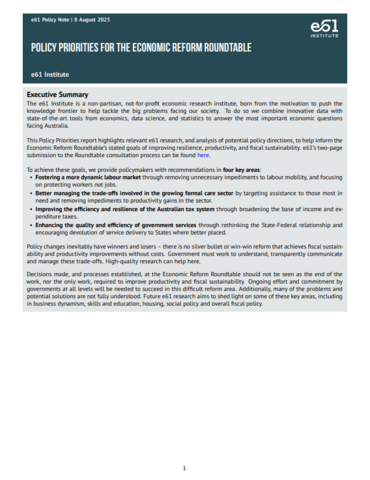
Policy priorities for the economic reform roundtable
Ahead of the upcoming Australian Government's Economic Reform Roundtable, this policy report highlights relevant research and potential policy directions aimed at achieving the Roundtable’s stated goals of improving resilience, productivity and fiscal sustainability. It provide policymakers with recommendations in four key areas.

Report
National Competition Policy analysis 2025: interim report
This interim report supports the National Competition Policy process by analysing the economic effects of two policy reforms: occupational licensing reform to promote labour mobility and adopting international and overseas standards. These two reforms would promote competition and increase Australia’s gross domestic product.

Report
Opportunities to improve the productivity of the construction industry
This interim report proposes a reform program to improve productivity across the Queensland construction industry. It finds that productivity in the industry had fallen 9% since 2018. It makes 21 recommendations and identifies 12 directions for reform, focused on four key areas: government procurement, land use and building activity regulation, and labour market operation.

Report
Productivity in the real world: what it is, what it isn’t, and how to make it work better for workers
Claims that Australia faces a productivity crisis are overblown, this report argues. It presents evidence showing productivity growth in recent decades has not been equally reflected in higher real wages and better living standards. Proactive measures to lift wages and living standards are needed if stronger productivity growth is to support stronger living standards.
Briefing paper
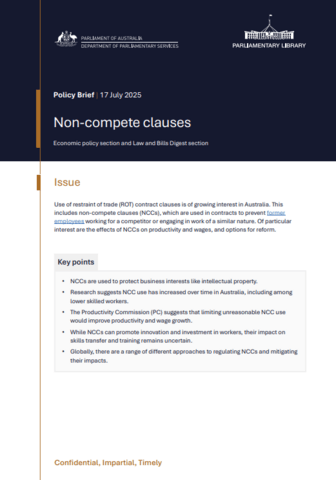
Non-compete clauses
Use of restraint of trade contract clauses is of growing interest in Australia. This includes non-compete clauses (NCCs). Of particular interest are the effects of NCCs on productivity and wages, and options for reform. This paper sets out the context, the arguments against NCCs, how other countries have regulated NCCs and the Australian Government's approach.