

Early intervention services
Journal article
Do Australian policies enable a primary health care system to identify family adversity and subsequently support these families - a scoping study
This scoping study reviewed 188 policies related to family adversity in Australia to determine if these policies both support a primary health care system that identifies family adversity such as childhood maltreatment, or parental mental illness and other household dysfunction, and are subsequently able to support these families.
Journal article
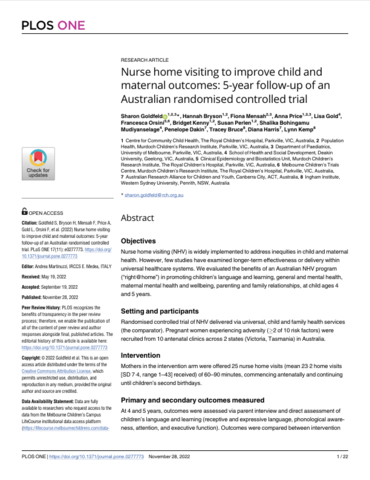
Nurse home visiting to improve child and maternal outcomes: 5-year follow-up of an Australian randomised controlled trial
An evaluation of the benefits of an Australian Nurse home visiting (NHV) program in promoting children’s language and learning, general and mental health, maternal mental health and wellbeing, and parenting and family relationships at child ages 4 and 5 years through a Randomised Control Trial. It concludes that the program promoted longer-term family functioning and...
Report
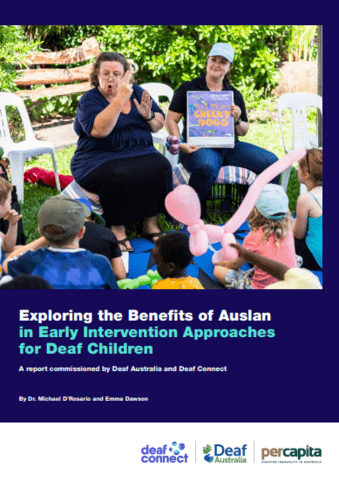
Exploring the benefits of Auslan in early intervention approaches for deaf children
The decision to support sign language as the first language for a deaf child is a complex one for parents, given that most deaf children are born into hearing families. The report concludes the critical period for language acquisition is a critical intervention window for deaf children and acknowledging the importance of the earliest plausible...

Evaluation
Evaluation of the pre-court support for adolescents using violence in the home (AVITH) pilot: final evaluation report
This evaluation represents an important addition to the evolving understanding of the issue of adolescent violence in the home (AVITH) and, in particular, the way in which Victoria’s current family violence response drives young people into contact with the justice system.

Report
Blueprint for a better future: paving the way for youth justice reform in Western Australia
This document outlines an evidence-based, alternative vision for a more effective and connected youth justice system in Western Australia. The report articulates a whole-of-system approach that responds to the underlying causes of offending to reduce crime, ensures the wellbeing of children and young people, and delivers safer and better futures for our most disadvantaged communities.