

Intimate Partner Violence (IPV)

Report
Smartphone sharing with intimate partners: implications for telecommunications consumer cybersecurity
While cybersecurity self-help advice is readily available to consumers, most advice is ill-suited to intimate relationship contexts where sharing is common. This study creates a new evidence base to understand everyday consumer smartphone sharing in intimate relationships to improve cybersecurity and technology design for all Australians.
Literature review
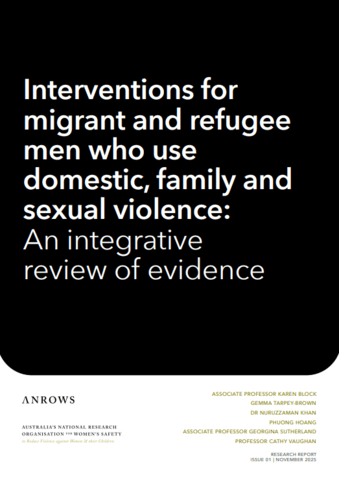
Interventions for migrant and refugee men who use domestic, family and sexual violence
For migrant and refugee families in Australia, domestic, family and sexual violence (DFSV) is perpetrated within the context of complex social factors. This review presents an analysis of current knowledge on interventions for migrant and refugee men who have used DFSV. It identifies best practice principles, programs and models relevant to implementation in Australia.
Submission
Victoria’s community safety story: stop violence at its source
Most recent statistics show Victoria is responding to men using violence too late and victim-survivors bear the brunt of this inaction. A comprehensive, integrated approach to stopping violence at its source is urgently needed. Victoria needs to do much more, much earlier. This submission outlines recommendations for the Victorian Budget.
Report
Yearly report to Parliament
This second yearly report to Parliament provides 30 recommendations for priority activities over the next 12 months to work towards achieving the outcomes of the National plan to end violence against women and children 2022-2032. The report contains case studies of work being done that we must learn from, share and scale to be able...
Report
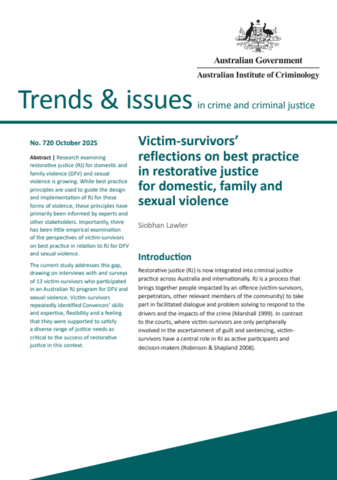
Victim-survivors' reflections on best practice in restorative justice for domestic, family and sexual violence
Research examining restorative justice (RJ) for domestic and family violence (DFV) and sexual violence is growing. However, there has been little empirical examination of the perspectives of victim-survivors on best practice. This study addresses this gap drawing on victim-survivor participants in an Australian RJ program.