

Child development
Report
Climate anxiety in pre-adolescent children
This report examines the psychological impact of climate change education on primary age children, arguing that the current approach is cognitively inappropriate and ethically questionable. It calls for a shift toward developmentally appropriate, psychologically safe and empowering environmental education. The report provides recommendations for policy and practice.
Briefing paper
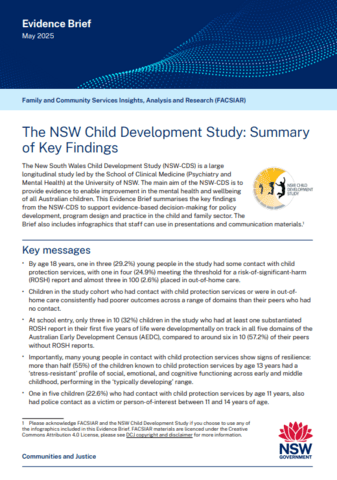
The NSW Child Development Study: summary of key findings
The main aim of the New South Wales Child Development Study (NSW-CDS) is to provide evidence to enable improvement in the mental health and wellbeing of all Australian children. This evidence brief summarises the key findings from the NSW-CDS to support evidence-based decision-making for policy development, program design and practice in the child and family...
Report
Assessing, differentiating, and reporting the functional strengths and support needs of children for whom there are developmental concerns
This report describes the development of an evidence-based and culturally responsive approach to addressing the current gap in knowledge and lack of consensus about how best to assess, differentiate and report children’s functional strengths and support needs. The framework will inform professional practice, operational guidance and decision-making.
Report
Better starts to school in South Australia: using linked data to investigate earlier opportunities to support positive school transitions
This report summarises a project identifying the factors which predict different types of transition to school. It finds that the case for early investment in children and families is clear. Evidence from the report includes estimates of the prevention potential if targeted effective supports were offered to specific priority populations early in life.
Briefing paper
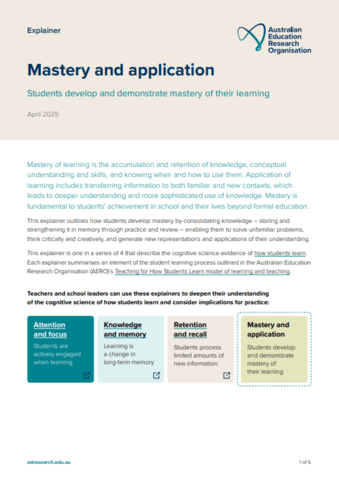
Mastery and application: students develop and demonstrate mastery of their learning
This explainer outlines how students develop mastery by consolidating knowledge – storing and strengthening it in memory through practice and review – enabling them to solve unfamiliar problems, think critically and creatively, and generate new representations and applications of their understanding.