

Aboriginal people (Australia)
Alternative labels
Aboriginal Australians
Evaluation
Evaluation of Services Our Way
This report outlines an evaluation of 'Services Our Way', a NSW Government service model designed to build the capacity of Aboriginal people to have greater access to mainstream and disability services and encourage self-directed support.
Working paper
Reconceptualising mobility for Aboriginal and Torres Strait Islander Australians
From first engagement between European settlers and Aboriginal and Torres Strait Islander peoples, the mobility patterns of Aboriginal and Torres Strait Islander peoples have been viewed as problematic, as random and unproductive. Subsequent policies to ‘civilise’ and ‘assimilate’ Aboriginal and Torres Strait Islander peoples into Western society aimed to sedentarise them. To this day such...
Report
National key performance indicators for Aboriginal and Torres Strait Islander primary health care: first national results June 2012 to June 2013
This report presents data for 19 ‘process of care’ and ‘health outcomes’ indicators which focus on the prevention and management of chronic disease, and maternal and child health, Aboriginal and Torres Strait Islander people. Summary This is the first national report on the Indigenous primary health-care national Key Performance Indicators (nKPIs) data collection. It covers...
Book
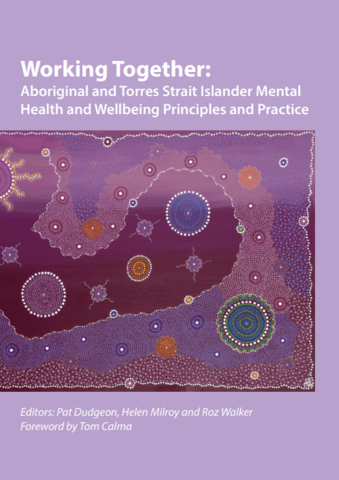
Working together: Aboriginal and Torres Strait Islander mental health and wellbeing principles and practice
The book is intended for staff and students and all health practitioners working in areas that support Indigenous mental health and wellbeing. It offers a high quality, comprehensive examination of issues and strategies influencing Aboriginal and Torres Strait Islander mental health and social and emotional wellbeing.
Dataset
3238.0 - Estimates and Projections, Aboriginal and Torres Strait Islander Australians, 2001 to 2026
Australia's Aboriginal and Torres Strait Islander population is projected to increase by over a third to reach between 907,800 and 945,600 people by 2026, according to this release.