

Prison sentences
Alternative labels
Imprisonment
Report
Thinking outside: alternatives to remand for children
The report is the result of twelve months research by Jesuit Social Services that was funded by a grant from the Legal Services Board Grants Program. Along with conventional social research methods, the approach was influenced by Jesuit Social Services’ long record of engagement in the field and its mission of seeking to build a...
Report
How much does imprisonment protect the community through incapacitation?
This paper focuses on imprisonment, as it is the most severe, iconic and resource-intensive form of incapacitation. It is the form most commonly assumed to be effective and is the focus of most empirical research into this subject. The incapacitative effect of imprisonment presents a compelling logic: while in prison, an offender cannot offend in...
Report
Sentencing children and young people in Victoria
Sentencing Children and Young People in Victoria covers the operation, functions, and philosophy of the Criminal Division of the Children’s Court. It presents a statistical profile of offences sentenced in the court, and identifies and analyses changes over a ten-year period (2000 to 2009 inclusive). The report also contains data on children and young people...
Fact sheet
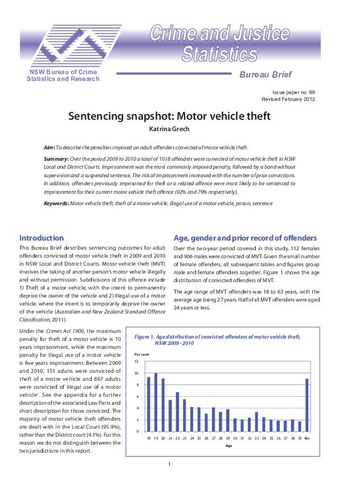
Sentencing snapshot: motor vehicle theft 2009-2010
This snapshot describes the penalties imposed on adult offenders convicted of motor vehicle theft. Over the period 2009 to 2010 a total of 1018 offenders were convicted of motor vehicle theft in NSW Local and District Courts. Imprisonment was the most commonly imposed penalty, followed by a bond without supervision and a suspended sentence. The...
Fact sheet
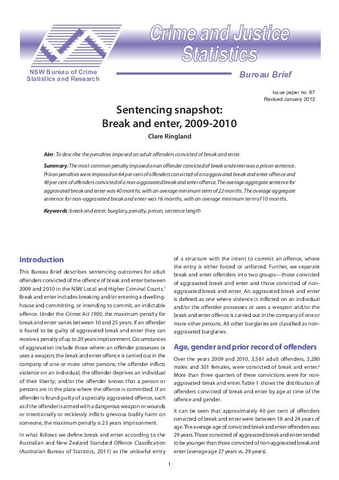
Sentencing snapshot: break and enter, 2009-2010
This snapshot describes the penalties imposed on adult offenders convicted of break and enter. The most common penalty imposed on an offender convicted of break and enter was a prison sentence. Prison penalties were imposed on 64 per cent of offenders convicted of an aggravated break and enter offence and 49 per cent of offenders...