

Randomised control trial
Alternative labels
RCT
Randomised trial
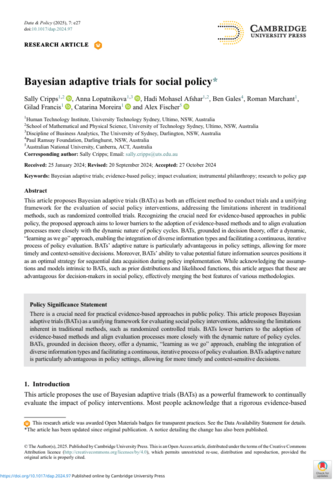
Journal article
Bayesian adaptive trials for social policy
There is a crucial need for practical evidence-based approaches in public policy. This article proposes Bayesian adaptive trials as an efficient method to conduct trials and as a unifying framework for the evaluation of social policy interventions. This approach addresses limitations inherent in traditional methods and recognises the need for evidence-based approaches in public policy.
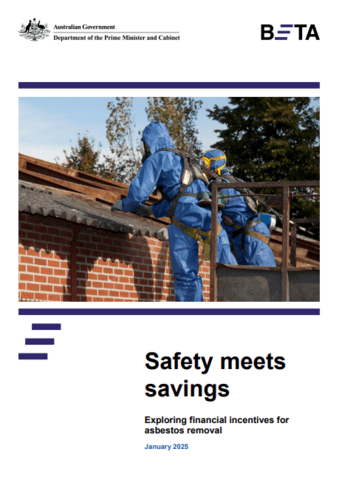
Evaluation
Safety meets savings: exploring financial incentives for asbestos removal
This report details the results of a randomised control trial to determine which financial incentives would encourage homeowners to proactively remove asbestos from their properties. The online study found that financial incentives could encourage asbestos removal if they cut immediate costs and provide additional benefits.
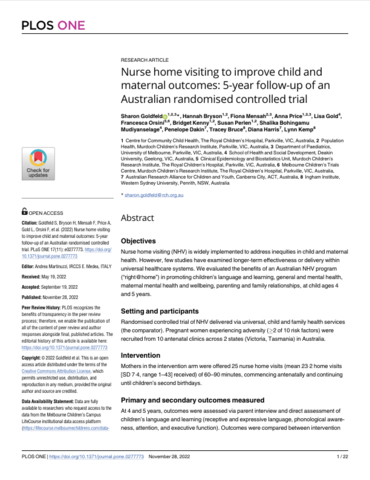
Journal article
Nurse home visiting to improve child and maternal outcomes: 5-year follow-up of an Australian randomised controlled trial
An evaluation of the benefits of an Australian Nurse home visiting (NHV) program in promoting children’s language and learning, general and mental health, maternal mental health and wellbeing, and parenting and family relationships at child ages 4 and 5 years through a Randomised Control Trial. It concludes that the program promoted longer-term family functioning and...
Evaluation
DACS: smarter safer homes to support older people living in their own homes through enhanced care models
This randomised control trial evaluated the use of home technology to support older community members living independently at home. The overall finding was that the home intervention benefited people's social care related quality of life and contributed to them staying in their own homes longer, although there were no benefits observed against secondary outcomes.
Evaluation
The Victorian Healthy Homes Program: research findings
The Victorian Healthy Homes Program was a randomised controlled trial designed to measure the impact of an energy efficiency and thermal comfort home upgrade on temperature, energy use, health and quality of life. It found that a modest home upgrade improved indoor warmth, health and gas use.