

Community participation
Alternative labels
Social participation
Participatory processes
Community involvement
Political participation
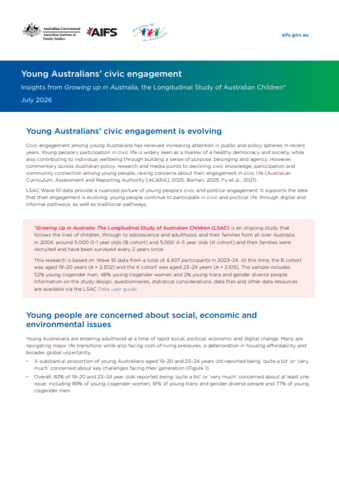
Research Summary
Young Australians’ civic engagement
This research snapshot from the Growing Up in Australia study provides a nuanced picture of young people’s civic and political engagement. It supports the idea that their engagement is evolving; young people continue to participate in civic and political life, through digital and informal pathways, as well as traditional pathways.
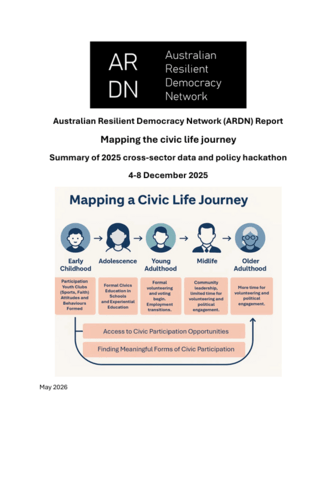
Report
Mapping the civic life journey: summary of 2025 cross-sector data and policy hackathon
Australia's civic participation is declining but across our lives we are active in different ways. This report summarises a forum to test the practical value of a civic life journey framework, looking at how policies could approach civic life from a life course perspective.
Report
Social infrastructure for digital skills development: the role of neighbourhood houses in supporting digital inclusion
This report outlines the critical role neighbourhood houses play in supporting digital inclusion in Victoria. Neighbourhood houses are not-for-profit, community-based centres that support skills development, social connection and community participation. The report has 6 recommendations that focus on investing in neighbourhood houses as critical community infrastructure.

Report
Neuroinclusion as imagination: from 'knowing for' to 'imagining with'
This paper argues that current neuroinclusion efforts in education, employment and public policy remain dominated by compliance‑led, deficit‑oriented models that position professionals as experts ‘knowing for’ neurodivergent people. It reconceptualises neuroinclusion as a participatory, imaginative practice where lived experience guides co‑designed policy, enabling more adaptive, just and future‑focused institutions.
Guide
Co-design toolkit
A toolkit supporting the development of services for early years. It is a practical set of resources created to enable local authorities and communities to design public services together. It can be used to support collaborative service design in local government and beyond, providing a starting point for local authority teams to use co-design approaches.