

Cyber-crime
Alternative labels
Cyberterrorism
Cyber attacks
Cyber crime
Report
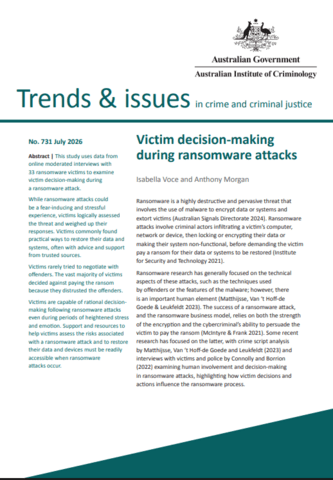
Victim decision-making during ransomware attacks
This study uses data from online Australians in moderated interviews with 33 ransomware victims to examine victim decision making during a ransomware attack. It finds that support and resources – to help victims assess the risks associated with a ransomware attack and to restore their data and devices – must be readily accessible when ransomware...
Report
Cybercrime in Australia 2025
The Cybercrime in Australia series aims to provide high-quality and robust evidence on self‑reported cybercrime victimisation, financial losses and other harms, help-seeking behaviour and, importantly, changes over time. This report offers insights into the experience of cybercrime among Australian individuals and small to medium businesses. One in five respondents experienced multiple types of cybercrime.
Report
Gender, technology and trafficking in persons: women’s experiences of forced criminality in South‑East Asia’s cyber‑scam centres
Over the past decade, cyber-scam centres dedicated to running online scams at a massive scale have proliferated across areas of South-East Asia. These centres themselves have become sites of significant exploitation. This research sought to understand women and girls’ experiences of trafficking into cyber-scam centres for forced criminality in the South East Asian region.
Report
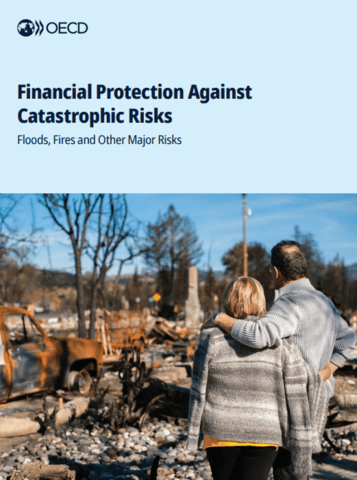
Financial protection against catastrophic risks
This report aims to help governments strengthen financial resilience against catastrophic risks. It provides a framework to assess the need for government-supported financial protection and the advantages and disadvantages of the main approaches to offering such support. It applies this framework to three types of large-scale risks: natural hazards, infectious disease outbreaks and cyber-attacks and...
Report
Perceived risk of victimisation by artificial intelligence enabled crimes
In the past 10 years, there has been a rapid proliferation of publicly available tools and applications using artificial intelligence (AI). Using Australian data, this report measured the perceived frequency of AI-enabled crimes and which specific technologies pose the greatest perceived risk of victimisation. The findings highlight priority areas for industry safeguards and public education.