

Public goods
Report
Key questions for AI in public institutions
This report explores how corporate Artificial Intelligence (AI) impacts institutions serving the public good, focusing on universities and social services. It invites reflection and critical questioning through thought‑provoking prompts. Designed to spark dialogue, advocacy and policy engagement, it offers resources that encourage deeper exploration of AI’s role through a Data Justice lens.

Report
Getting better use from infrastructure
The Victorian Government owns about $400 billion of land and infrastructure. When community needs change or infrastructure ages, building new infrastructure is not the only answer. The government can also upgrade existing infrastructure, maintain it better or change how people use it. This report examines how Victorian Government agencies manage public infrastructure and how they...
Report
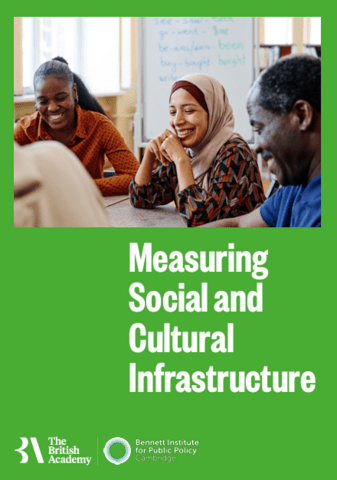
Measuring social and cultural infrastructure
This report brings together the results of an investigation into how best to measure social and cultural infrastructure. It develops a framework for measuring the assets, facilities and spaces that make up shared social and cultural infrastructure, and considers its practical applications for a range of organisations.
Report
The economics of shared digital infrastructures: a framework for assessing societal value
This paper highlights the importance of treating digital technologies as infrastructure to avoid fragmentation, duplication and costly inefficiencies. It proposes a public value measurement framework for digital infrastructure and identifies four key policy implications.
Report
AI, innovation and the public good: a new policy playbook
Reflecting on recent developments in open-source artificial intelligence (AI), this report examines how a national innovation system framework can guide AI industrial policy to foster innovation and reduce reliance on dominant tech companies. It argues that aligning trade policy with industrial policy and competition is critical for fostering a fair and dynamic AI ecosystem.