

Rural health

Discussion paper
Abortion access in South Australia
This report analysed publicly available data from South Australia and found that 18% of the population who might need abortion care live in country areas but under 3% of abortions are coordinated in country-based health services. The report recommends changes to improve access to abortion care in country South Australia.

Journal article
Designing mentorship for constrained systems
Mentorship is widely recognised as a valuable strategy for supporting health professionals. This article examines how mentorship can be designed for constrained health systems, including in rural and remote settings. It proposes a systems-oriented perspective that positions mentorship as part of routine practice rather than as a separate professional development activity.

Evaluation
Specialist Training Program evaluation and targeted stakeholder engagement final report
An evaluation of the Specialist Training Program (STP) which aims to improve the future specialist workforce by extending non-GP specialist medical training into regional, rural, remote and private healthcare settings. The process evaluation provides an assessment of the STP to date and considers how the program could be improved.
Report
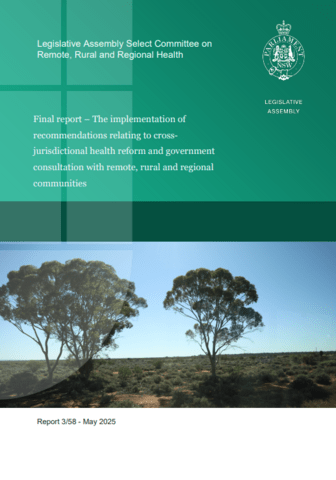
Final report: the implementation of recommendations relating to cross-jurisdictional health reform and government consultation with remote, rural and regional communities
This report examines cross-jurisdictional health reform, collaboration and government consultation with remote, rural and regional communities in New South Wales. It finds that rural and remote primary care is in crisis and proposes a pathway forward to facilitate reform. The report presents 12 findings and 18 recommendations.
Journal article
Remote health: what are the problems and what can we do about them?
This article analyses three broad questions: how is ‘remote’ different from ‘rural’; how do these differences affect the provision of health care and health outcomes, positively and negatively; and what is needed to address these issues and systematise solutions in order to deliver parity of health outcomes. It finds the distinguishing characteristics of remote areas...