

Sustainability
Alternative labels
Environmental economics
Conservation funding
Sustainability and the environment

Conference paper
"Can we meaningfully ""operationalise"" the ecological footprint calculation at the organisational level?"
This presentation aims to trace the approach taken in delivering the Ecological Footprint project across 3 very different local government organisations and their communities, some of the details and results of the various projects carried out, and the learning which may be of use to similar organisations or future project areas related to engaging with...
Conference paper
Keeping ahead of the Joneses: the incompatibility of urban environmental efficiency and development practices in suburbs undergoing renewal.
This paper reports on a study of a suburb in Canberra that has experienced significant redevelopment of houses in the last eight years. It finds that, despite the majority planners, architects, building designers and residents expressing a desire to achieve a more environmentally efficient outcome, very few houses achieved this ambition.
Conference paper
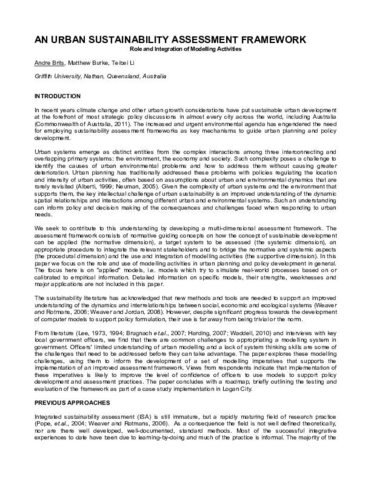
An urban sustainability assessment framework: role and integration of modelling activities
This paper focuses on the role and use of modelling activities in urban planning and policy development in general. The focus here is on "applied" models, i.e. models which try to simulate real-world processes based on or calibrated to empirical information.
Briefing paper
"Yes we can …": Using benefit transfer to inform environmental policy making
The use of economic analysis in environmental and resource policy issues A number of current policy debates in Australia revolve around natural resource and environmental management issues. In many cases these issues have come to public attention through the efforts of special interest groups. Once such issues are accepted in the political process as requiring...
Report
Cross-connections: linking urban water managers with humanities, arts and social sciences researchers
This research project identified key issues affecting collaboration between science; and humanities, arts and social sciences. These concerns include resource imbalance, generalised attitudes and difficulties translating social research findings into practical knowledge. It recommends stronger collaboration right from the outset of projects to jointly define project objectives, scope and processes, rather than seeking to engage...