

Briefing paper
Briefing paper
Loneliness by numbers: a South Australian snapshot – August 2025
This snapshot explores what is loneliness, who is affected and how to overcome the issue. It presents the survey results of South Australians who were asked to report their experiences of loneliness, lacking companionship, feeling left out or isolated. The report provides recommendations for individuals, communities and governments.
Briefing paper
Securing sovereign capacity: strengthening national resilience in the refined metals sector
Aggressive geoeconomic interference by Beijing will soon devastate Australia’s smelting and metal refining regions unless the Federal Government acts decisively according to this report. The report finds that China is now spending more on industrial subsidisation than on defence. A loss of refining capacity means an undermining of sovereign capacity.
Briefing paper
From fragmented to future-ready: reforming research in Australia
This paper posits that Australia’s fragmented research system and shrinking research workforce is undermining national productivity. Funding is too fragmented, the rules are too complicated and there is a lack of coordination across government. The paper suggests that aligning similar programs under the same portfolio – and linking strategy to delivery – is common sense.
Briefing paper
How are countries balancing teaching staff compensation with broader education investment?
Teachers’ salaries consistently represent the largest spending item in public primary and secondary educational institutions across OECD countries and are often the subject of debate. This policy brief outlines spending patterns across OECD countries, highlighting the complexity of implementing broad salary reforms. It finds that even modest salary increases for teachers can have a significant...
Briefing paper
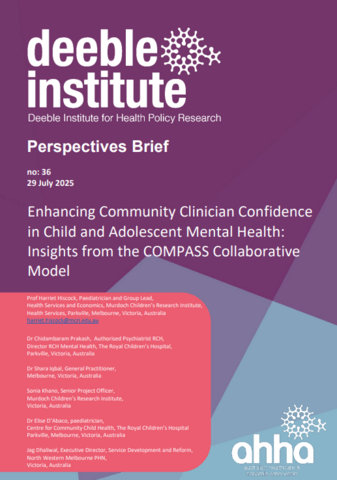
Enhancing community clinician confidence in child and adolescent mental health
This paper reviews the COMPASS model, developed in response to the demand for paediatric mental health services during the COVID-19 pandemic. The model effectively enhanced clinician confidence in managing child and adolescent mental health disorders, reduced reliance on specialists’ services, fostered collaborative care and supported clinician wellbeing. The paper suggests the model could be scaled...