

Australia
Report
Social insecurity: cohesion, outrage economics and national resilience in Australia
The report warns Australia’s social cohesion is under sustained pressure. It argues that social cohesion should be treated as a core pillar of national security, aligning leadership, policing, education, regulation and community investment around three objectives: protecting freedom while maintaining order, enabling disagreement without disorder and rebuilding a shared sense of belonging.
Evaluation
Evaluation of younger people in residential aged care initiatives
The evaluation assessed the appropriateness, effectiveness and sustainability of Australian Government-funded initiatives introduced since 2019 to reduce the number of younger people in residential aged care and lessons learned to inform future policy considerations. It found several factors helped reduce younger people entering residential aged care but not to zero.
Report
Suicide prevention policy development and monitoring
Suicide is the leading cause of death for Australians aged 15 to 44 years. From 2022–23 to 2025–26, the Department of Health, Disability and Ageing administered 41 suicide prevention measures. This report finds that four to five years after several national agreements, objectives to reduce suicide have not been achieved.

Briefing paper
Fuel shock: why clean energy is our best defence
The escalating conflict in Iran and neighbouring countries is a significant risk to Australian households. When fossil fuel supply is threatened, prices spike and Australians pay. This is Australia’s core energy vulnerability. This paper proposes to reduce dependence by accelerating renewable energy and the electrification of homes, businesses and transport.
Briefing paper
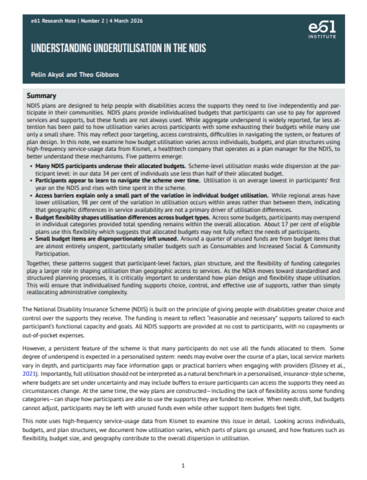
Understanding underutilisation in the NDIS
National Disability Insurance Scheme (NDIS) plans are designed to help people with disabilities access the supports they need to live independently and participate in their communities. NDIS plans provide individualised budgets that participants can use to pay for approved services and supports. This note examines how budget utilisation varies across individuals, budgets and plan structures.