

Queensland
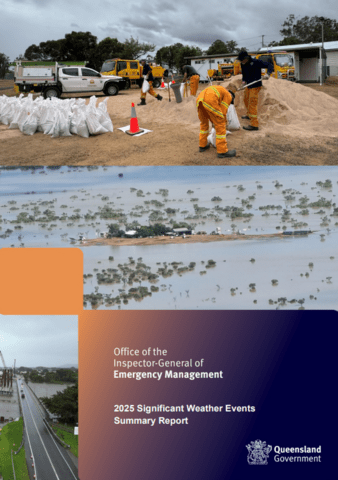
Report
2025 Significant weather events
This report draws together findings from three event reports to provide a consolidated, system‑level view of disaster management performance during the 2025 significant weather events in Queensland. It identifies common strengths, recurring challenges and cross‑cutting themes, and considers how lessons observed can inform future policy, planning, training and operational practice across Queensland’s disaster management arrangements.
Report
Inquiry into elder abuse in Queensland
This report presents a summary of a Queensland inquiry into elder abuse. The inquiry considered the nature and extent of elder abuse, the effectiveness and cohesiveness of responses to elder abuse, and opportunities to improve responses to elder abuse within the government, broader community, non-government and private sectors. The report provides 16 recommendations.
Discussion paper
Beyond shelter: integrating mental health support in temporary supported accommodation
Mental health and homelessness are deeply interconnected, yet temporary supported accommodation (TSA) services struggle to address this intersectionality. This paper critically analyses TSA services, exploring the question: ‘How can TSA be improved to better support individuals experiencing homelessness and mental health concerns?’ It explores how integrating psychologically informed environments within TSA could enhance their capacity.
Report
In plain sight: review into system responses to child sexual abuse
The review examined system responses to child sexual abuse in Queensland, with a focus on the early childhood education and care sector, police services and the blue card system, using the case of a convicted offender of child sexual abuse as a case study. It made recommendations for improvements needed to laws, policies, procedures and...
Report
Governance in the age of AI: readiness and responsible leadership
The deployment of AI-enabled services within the public sector raises complex challenges. While the value of these services is increasingly clear, the critical question is whether the organisation or government department is organisationally, technically and ethically prepared to deploy these services responsibly and at scale. This paper seeks to address that readiness gap.