

Research Summary
 SHARE
SHARE
Resilience from early to middle childhood in children known to child protection services
Publisher
Early childhood education
Child safety
Child development
Early childhood development
Child protection
New South Wales
Resources
| Attachment | Size |
|---|---|
 Resilience from early to middle childhood in children known to child protection services Resilience from early to middle childhood in children known to child protection services
|
215.83 KB |
Description
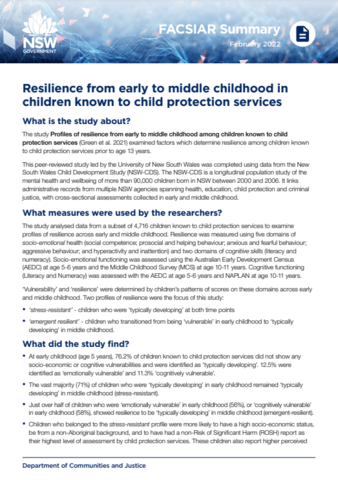
Findings from a NSW Child Development Study (NSW-CDS) paper led by the University of New South Wales that examined factors which determine resilience among children known to child protection services prior to age 13 years. The NSW-CDS is a longitudinal population study of the mental health and wellbeing of more than 90,000 children born in NSW between 2000 and 2006. It links administrative records from multiple NSW agencies spanning health, education, child protection and criminal justice, with cross-sectional assessments collected in early and middle childhood.
What did the study find?
- At early childhood (age 5 years), 76.2% of children known to child protection services did not show any socio-economic or cognitive vulnerabilities and were identified as ‘typically developing’. 12.5% were identified as ‘emotionally vulnerable’ and 11.3% ‘cognitively vulnerable’.
- The vast majority (71%) of children who were ‘typically developing’ in early childhood remained ‘typically developing’ in middle childhood (stress-resistant).
- Just over half of children who were ‘emotionally vulnerable’ in early childhood (56%), or ‘cognitively vulnerable’ in early childhood (58%), showed resilience to be ‘typically developing’ in middle childhood (emergent-resilient).
- Children who belonged to the stress-resistant profile were more likely to have a high socio-economic status, be from a non-Aboriginal background, and to have had a non-Risk of Significant Harm (ROSH) report as their highest level of assessment by child protection services.
- Children who belonged to the emergent-resilient profile were more likely to have no substantiated ROSH reports after the age of 5 years and to report having community supports.
Publication Details
Copyright:
Department of Communities and Justice, State of NSW 2022
Access Rights Type:
open
Series:
FACSIAR Summary February 2022
Post date:
28 Mar 2023
