

 SHARE
SHARE
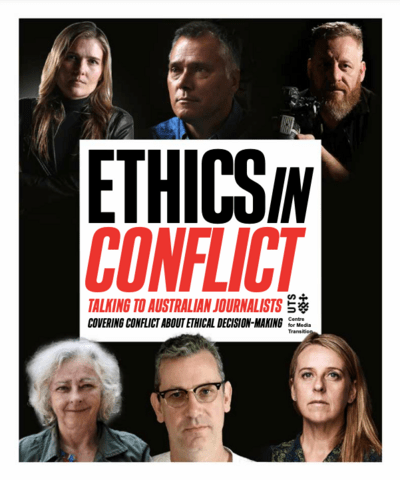
Ethics in conflict: talking to Australian Journalists covering conflict about ethical decision-making

No field of news reporting is more dangerous than reporting conflict. Dangers abound for journalists, their crews, their local fixers and their producers. And there are dangers for those they are reporting on and their contacts. However, not enough is known about how journalists apply ethics in the face of all these dangers, and in the face of various competing interests and loyalties. This research report is the result of a partnership between the International Committee of the Red Cross (ICRC) and the Centre for Media Transition (CMT), University of Technology Sydney (UTS). It aims to explore the ways in which journalists navigate the often-treacherous terrain of ethics in conflict zones.
Humanitarian agencies work on the basis of a commitment to ‘do no harm’; their clear objective is to help those in crisis. But what about journalists? They report on the conflicts and other disasters that are of public interest value for audiences, and sometimes circumstance demands that they work hand-in-hand with humanitarian agencies, but do they share the same motives? Or do they play by their own – different – ethical rules?
The tricky ethical decisions facing reporters in conflict zones and in humanitarian crises are not abating. Indeed, they are likely to compound, as conflicts and crises continue to be drawn out, and as much legacy journalism finds itself in an ongoing and debilitating financial crisis, paving the way for more fly-in reporters without institutional backing. It is an unfortunate fact that when newsrooms consider budget cuts, they think first of cutting foreign bureaux when they have them, or international coverage generally. All of which makes it vitally important to shine a light on how reporters in conflicts and crises are making ethical decisions. That’s what this project aims to do, for the benefit of journalists present and future, but also for the benefit of those they report on, and, in turn, for the benefit of journalism’s audiences.
For the report, six former and current correspondents and photojournalists with experience reporting on conflict were interviewed: Sophie McNeill, Stan Grant, Richard Murray, Ginny Stein, Gary Ramage and Kate Geraghty
