

Organisation
OECD Publishing
Owning Institution:
Working paper
Beyond grades: raising the visibility and impact of PISA data on students’ well-being
In 2015, PISA broke new ground by including indicators of student well-being alongside traditional measures of academic performance. This paper presents a proposal to increase the visibility and policy impact of PISA indicators on well-being, by organising them in thematic areas and presenting them through data visualisations that respond to the needs of different kinds...
Policy report
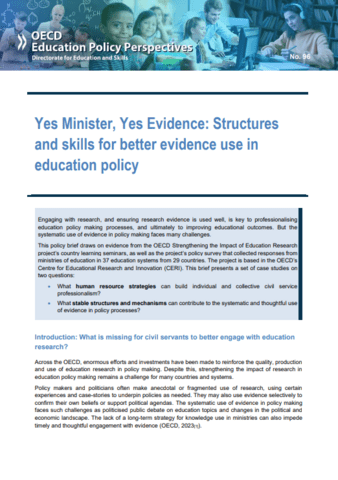
Yes minister, yes evidence: structures and skills for better evidence use in education policy
Policy-makers and politicians often make anecdotal or fragmented use of research, using certain experiences and case stories to underpin policies as needed. They may also use evidence selectively to confirm their own beliefs or support political agendas. This paper has been prepared to support policy-makers’ research engagement skills that are needed at an organisational and...
Policy report
Regulatory experimentation: moving ahead on the agile regulatory governance agenda
This policy paper examines key concepts, definitions and constitutive elements of regulatory experimentation. It outlines the rationale for using regulatory experimentation, discusses enabling factors and governance requirements, and presents a set of forward-looking conclusions.
Working paper
Beyond literacy: the incremental value of non-cognitive skills
This paper reviews a number of previous studies that have investigated how measure of non-cognitive skills predict important life outcomes such as educational attainment, employment, earnings, and self-reported health and life satisfaction.
Report
Generative AI for anti-corruption and integrity in government
This paper draws on input from the OECD integrity and anti-corruption communities and provides a snapshot of the ways these bodies are using Generative AI and large language models (LLMs), the challenges they face, and the insights these experiences offer to similar bodies in other countries.