

Organisation
Social Wellbeing Agency (New Zealand)
Owning Institution:
Website:
Report
Building an evidence base for understanding veteran outcomes
Researchers constructed an indicator of veteran status, drawing together data from a range of datasets to identify a group of people who are likely to be veterans. Compared to the general population, veterans experienced fewer impairments before age 30, but more severe impairments from age 65. After age 65 most (75%) veterans were living with...
Research Summary
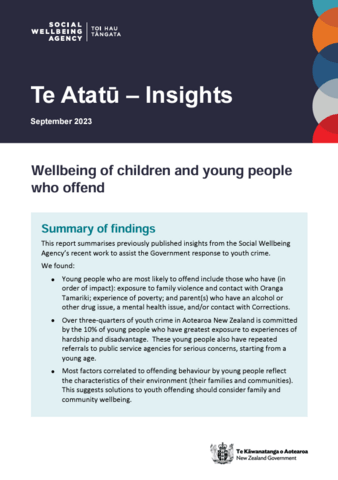
Wellbeing of children and young people who offend
This report summarises previously published insights from the Social Wellbeing Agency’s work assisting the New Zealand Government's response to youth crime. The report looks at wellbeing factors that are highly correlated to offending behaviour in young people and outlines ways that policymakers can reduce crime by targeting better support to young people and their families.

Report
Te Ao Māori perspectives of what works to support wellbeing in the first thousand days
The purpose of this report was to identify what works to support wellbeing in the first thousand days from a Te Ao Māori (Māori world view) perspective. Whilst this report provides insights into Māori perspectives of tamariki wellbeing, it is uniquely focused on the review of exemplar initiatives that are grounded in Te Ao Māori.

Report
Public and private debt: links between debt types for all New Zealanders
Debt takes many forms in an established financial system. This paper focuses on two categories of debt based on who the debt is owed to - public debt (debt owed to the government) and private debt (debt owed to non-government lenders).

Policy report
Identifying effective policy responses to the COVID-19 pandemic
This report summarises a series of analyses conducted by the Social Wellbeing Agency to determine the effectiveness of several responses aiming to reduce the spread of COVID-19. This involved comparing data on COVID-19 policies to reported case rates in New Zealand and 49 similar countries.