

Organisation
Australian Institute of Family Studies
Owning Institution:
Acronym:
AIFS
Website:

Report
Future-proofing safety: COVID-19 and family violence in Victoria 2020-2021
This is the final report for the 'Future-proofing Safety' project, funded by Family Safety Victoria. The report highlights the significant challenges and specific opportunities for services and clients that emerged during COVID-19. These include elevated client risk and need, changed service responses, gaps and weaknesses within the family violence and sexual assault service system, and...
Guide
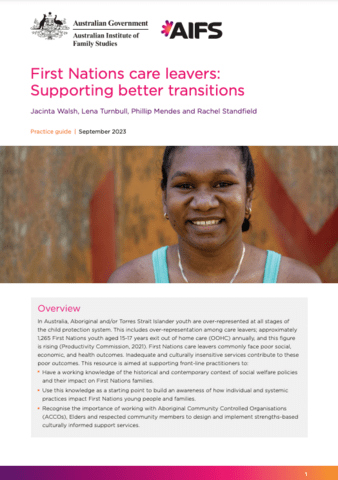
First Nations care leavers: supporting better transitions
In Australia, Aboriginal and/or Torres Strait Islander youth are over-represented at all stages of the child protection system. This resource is aimed at supporting front-line practitioners.
Research Summary
Parents’ welfare receipt and their children’s employment and education outcomes
This snapshot shows that children who grow up with a parent receiving welfare payments (especially for longer total durations) are themselves at risk of not being in education, employment or training at age 18–19. This finding presents several implications for Australian policy and practice.

Literature review
Coercive control literature review: final report
This report presents a literature review on coercive control in the context of domestic and family violence, with a particular focus on the understanding of, and responses to coercive control in the Australian context.

Guide
Reproductive coercion and abuse
Reproductive coercion and abuse (RCA) refers to any deliberate attempt to dictate a person’s reproductive choices or interfere with their reproductive autonomy. This practice guide is for non-specialist practitioners working in areas that increase the likelihood of exposure to women experiencing RCA but do not have specialist training or experience in domestic and family violence.