

Briefing paper
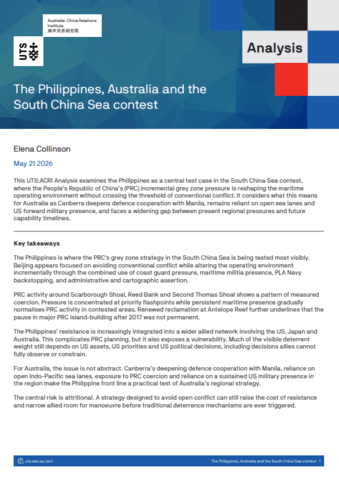
The Philippines, Australia and the South China Sea contest
This analysis examines the Philippines as a central test case in the South China Sea contest, where the People’s Republic of China is reshaping the maritime operating environment. The case also matters directly for Australia. Canberra is not a South China Sea claimant, but it depends on open maritime routes and is deepening defence cooperation...
Report
In limbo: perspectives on Australia-China research mobility
This report describes the results of qualitative research undertaken with Chinese nationals applying for visas to study or conduct research in Australia. It provides insight into how visa policies and administrative practices are experienced and interpreted by applicants, highlighting the human dimensions of mobility.
Report
Artificial intelligence, cognitive offloading and implications for education
This report investigates the challenge driven by the rapidly expanding use of artificial intelligence (AI) in schooling: the risk that students will outsource too much of the cognitive work that is crucial to establishing knowledge, skill and ‘thinking infrastructure’. The report includes specific recommendations for policy and teaching and learning strategies.
Briefing paper
The qualities of leadership in the public sector
Leadership is recognised as a significant foundation of the public sector. The success or failure of any public enterprise is often associated with the vision and strength of the leadership involved. This paper aims to synthesise the vast leadership literature around core ideas that relate closely to policy and practice in the public sector.

Survey Report
The Australia-China relationship: what do Australians think?
The 2025 poll provides up-to-date insights into how Australians interpret and assess the relationship with China. Now in its fifth year, the survey continues to track shifts in public sentiment across security, economic, political and social dimensions. The findings point to a national mood that has generally stabilised.