

Report
It’s about IP and not IT: knowledge capital and the Australia-US productivity gap
Australia’s market-sector labour productivity has steadily fallen behind the United States (US) over the past decade. This research note explores the productivity gap and finds that in addition to lower rates of IP investment in Australia, there is also limited diffusion of US knowledge capital to Australian firms and industries.
Report
More than a feeling: high inflation and weak consumer sentiment
This research links the decline in consumer sentiment in Australia to the cumulative, broad-based impact of high inflation on consumer purchasing power. The evidence suggests it is the persistent price pressures, rather than mortgage rates which are driving the pessimism across all household types, suggesting a return to confidence depends on inflation easing back.
Report
Moving to the country: analysing regional migrant outcomes
Regional visas are a growing part of Australia’s skilled migration system. They are intended to support regional economies and ease pressure on major cities. However this analysis finds many regional visa holders are not in places the public may think of as 'regional'. It concludes that regional policy may not be having its desired effect.
Report
Death of a salesperson: the decline in self-employment in the 21st century
Australia’s self-employment rate has fallen sharply since the early 2000s. This report shows a fall in unincorporated self-employment aligns closely with changing labour market incentives. Unincorporated businesses that employ workers experienced the greatest decline, while solo self-employment fell modestly and the share of company owners grew. The patterns are interpreted as reflecting two broad trends.
Briefing paper
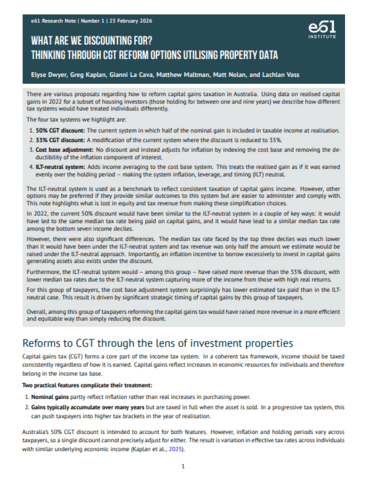
What are we discounting for? Thinking through CGT reform options utilising property data
There are various proposals regarding how to reform capital gains taxation in Australia. Using data on realised capital gains in 2022 for a subset of housing investors (those holding for between one and nine years) this paper describes how four different tax systems, including the current system, would have treated individuals differently.